

New Materials for Industrial 3d Printing
3D printing is now a mature technology for industrial production as well, not just for prototyping.
Today the market demands functional filaments with specific characteristics – such as electrical conductivity, flame retardancy or X-ray opacity – capable of producing high-performance technical components and operational devices.
In this context, LATI Industria Termoplastici S.p.A., leveraging its experience in special thermoplastic compounds, has developed a range of filaments for additive manufacturing intended for professional and industrial applications.
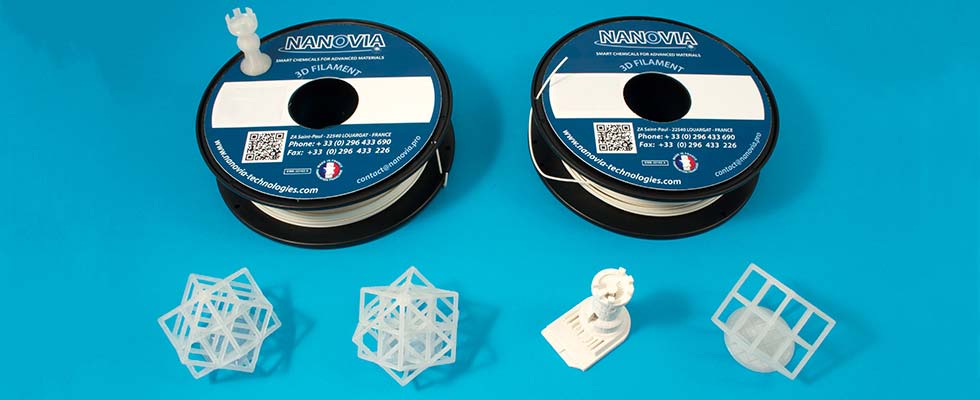
Among these stands out the radiopaque filament for 3D printing, developed in collaboration with Nanovia, a leading company in the production of materials for Fused Filament Fabrication (FFF).
LATIGRAY Radiopaque Filament: Performance and Functionality
LATI and Nanovia have co-designed a radiopaque compound intended for the manufacture of X-ray opaque filaments, used particularly in the medical and personal care sector.
The result is LATIGRAY, an innovative material formulated on a modified PLA or PC matrix, loaded up to 70% by weight with high-density ceramics.
Main Properties of LATIGRAY Radiopaque Filament:
- Adjustable X-ray opacity based on ceramic content.
- Excellent surface quality even with high filler levels.
- Excellent adhesion between printed layers, without delamination.
- Compatibility with standard nozzles for FFF extrusion.
- Dimensional stability and absence of deformation during cooling.
- Controlled melt rheology, ensuring rapid and continuous deposition.
Thanks to the homogeneous distribution of ceramic material and optimized viscosity, LATIGRAY filament produces compact and precise objects, with a high level of finish even in minute details.
Applications and Sectors of Use
The radiopaque filament for 3D printing finds application in various industrial and medical sectors:
| Sector | Main applications | Benefits |
| Medical | Surgical guides, diagnostic instruments, X-ray visible supports | Radiovisibility, dimensional precision |
| Research and development | Modeling of functional prototypes for imaging | Non-destructive structural control |
| Industrial additive manufacturing | Technical components with opacity requirements | Compatibility with professional FFF systems |
This technology enables the production of customized radiopaque components, useful for radiographic controls or applications where it is necessary to visualize the component under X-ray imaging without the use of metals.
LATI’s Experience in Additive Manufacturing
The development of LATIGRAY represented an important technological challenge, requiring LATI to adapt its compounding processes – traditionally oriented toward injection molding – to the requirements of 3D filament extrusion.
This evolution has led to the creation of a line of materials for 3D printing that includes:
- Electrically conductive filaments.
- Self-lubricating compounds.
- Flame-retardant grades.
- Metal detector detectable materials.
A Step Forward toward Functional Additive Production
LATI confirms its ability to innovate in the additive manufacturing materials sector, offering customized solutions for industrial makers and professional manufacturers seeking superior technical performance.
The LATIGRAY radiopaque filament demonstrates how 3D printing can evolve from prototyping technology to industrial production tool for functional, precise and controllable components.
Conclusion
Discover LATI’s range of technical filaments for 3D printing, including the LATIGRAY radiopaque filament, ideal for medical and industrial applications.
Learn more about solutions at www.lati.com.
FAQ – Radiopaque Filament for 3d Printing
- What does it mean that a filament is radiopaque?
A radiopaque filament contains high-density fillers that make it visible to X-rays, useful for diagnostic or industrial controls. - In which materials is the LATIGRAY radiopaque filament available?
It is available on PLA and modified PC base, with ceramic loading up to 70% by weight. - Is it compatible with standard FFF printers?
Yes, the filament can be extruded with standard nozzles and does not require special equipment for printing.
 Accessibility Statement