

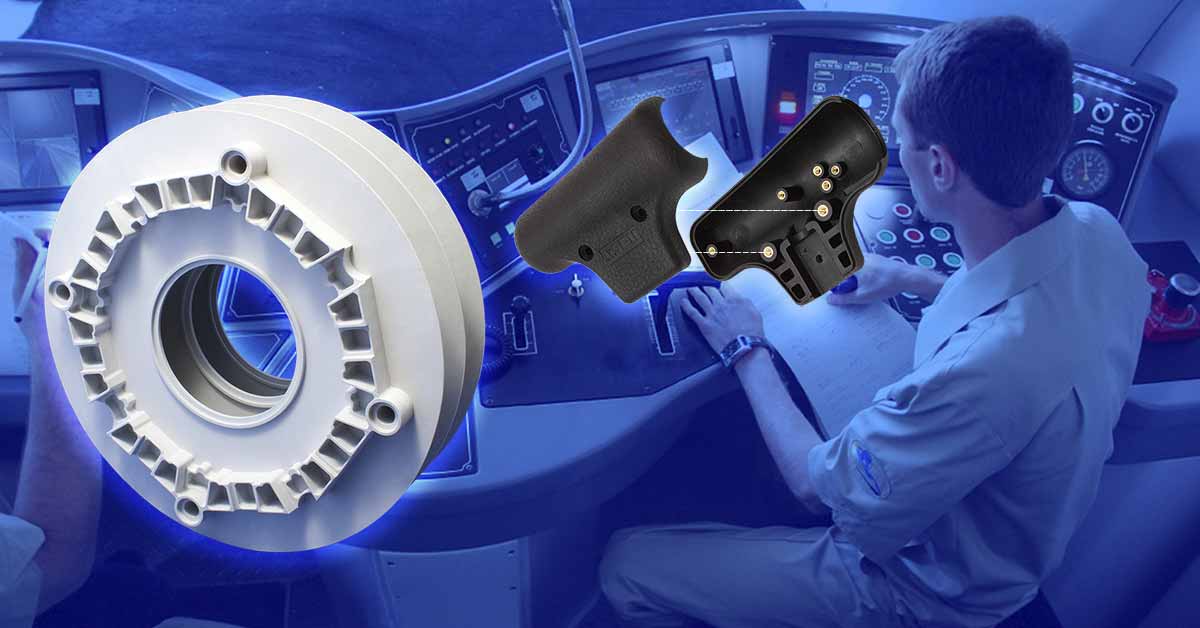
In the landscape of materials for the railway sector, the use of flame-retardant compounds is now an essential standard. Designers in the industry require polymers that guarantee maximum fire safety, mechanical strength and low environmental impact, in line with the most stringent European regulations.
Fire Safety and EN45545 Standard
Halogen-free Flame Retardants: a Fundamental Requirement
The new compounds of the V0HF1 family are distinguished by the absence of:
- halogens
- red phosphorus
- antimony
This characteristic allows for reduced smoke toxicity in case of fire, improving passenger safety and on-board personnel safety.
Compliance with EN45545 Standard
The EN45545 is the European standard that regulates the fire behavior of materials used in railway vehicles. LATI compounds meet the risk levels:
- HL1-HL2-HL3, for both internal (R22) and external (R23) applications to the train body.
Application Case: Filtration Systems for Railway Cabins
A major German multinational active in the field of air filters for railway cabins has selected LATAMID 66 H2 G/25-V0HF1 to produce the fastening components of the filter modules.
Why was this compound chosen?
| Characteristic | Detail |
| Base polymer | PA66 reinforced with 25% glass fiber |
| Flame retardancy | UL94 V0 up to 0.75 mm |
| Certifications | EN45545 R22-R23 HL3 |
| Dimensional stability | High, even under stress |
| Mechanical strength | Static and dynamic, high |
These performances make the material ideal for applications subject to vibrations, thermal variations, and stringent geometric requirements.
The V0hf1 Range: Versatility and Reinforcements up to 50%
The V0HF1 compound family includes formulations based on:
- PA66 (25-50% glass fiber)
- PBT
- PPA
All grades are covered by UL certification and are designed to meet even the most extreme mechanical demands, for example in contexts where thermoset materials are being replaced.
FAQ – Frequently Asked Questions about Flame-Retardant Compounds for the Railway Sector
- What does the EN45545 standard require for plastic materials?
Fire behavior, smoke opacity, and toxicity. Compounds must pass tests for HL1-HL2-HL3 levels depending on the intended use. - Are halogen-free flame-retardant compounds truly effective?
Yes. They offer high fire-retardant performance with lower toxic smoke emission, ensuring safety without compromises. - What are the advantages compared to thermoset materials?
Reinforced thermoplastics are lighter, recyclable, and easily processable via molding, with high mechanical performance.
Conclusion and Invitation for further Information
Flame-retardant compounds for the railway sector are establishing themselves as the ideal solution for applications where safety, resistance, and sustainability are critical requirements. Thanks to formulations free of critical substances and international certifications, these materials are widely used in internal, external, and structural components for rail vehicles.
🔧 Want to explore solutions for your railway application?
Request a technical consultation to evaluate the most suitable flame-retardant compound for your specific needs.
 Accessibility Statement