

Venturi Effect Hydraulic Pumps: Efficiency without Electrical Power
Moving water without using electrical power represents one of the most interesting challenges in modern hydraulic technology.
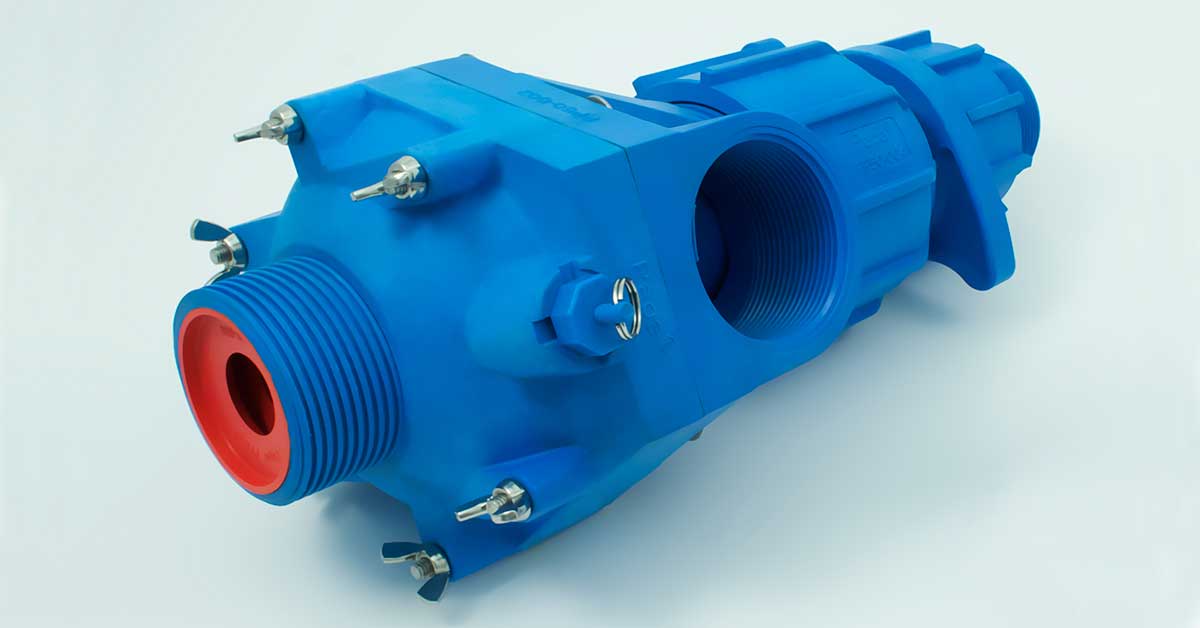
This includes the “PAPA Pumps” Venturi effect pump, a system capable of moving up to 20,000 liters of water per day using only the kinetic energy of the inlet flow, without interruptions and maintenance-free.
Designed to function even in critical environmental conditions — such as dirty, sandy, or contaminated water, typical of agricultural channels and natural waterways — this pump combines hydraulic efficiency, ease of use, and reliability.
Its lightweight design and easy installation make it ideal for use in agriculture, emergency water management, irrigation, and remote locations, including developing countries.
From Metals to Polymers: a New Generation of Hydraulic Pumps
Traditionally, hydraulic ram pumps were made of steel or bronze, solid but heavy, expensive, and unsustainable materials.
The English company PAPA Pumps decided to revolutionize the hydraulic pump concept by replacing metals with a thermoplastic compound for hydraulic pumps, combining mechanical strength, recyclability, and reduced environmental impact.
After testing various materials, the choice fell on LATIGLOSS 66 H2 G/50 F2, a PA66-based thermoplastic compound reinforced with 50% glass fiber, specifically formulated to ensure structural strength, lightness, and environmental compatibility.
LATIGLOSS 66 H2 G/50 F2: Compound for Advanced Hydraulic Performance
The LATIGLOSS 66 H2 G/50 F2 offers an optimal balance between mechanical strength, rigidity, and surface finish, making it ideal for components subject to high internal pressures such as Venturi effect pumps.
| Property | Typical Value | Technical Benefit |
| Polymer base | Polyamide 66 (PA66) | High mechanical and thermal resistance |
| Reinforcement | 50% glass fiber | High rigidity and dimensional stability |
| Density | 1.57 g/cm³ | ~80% lighter than steel |
| Breaking stress | >2000 kg/cm² | Structural resistance to high pressures |
| Operating temperature | >100°C | Thermal stability even in continuous use |
| Drinking water certifications | KTW, NSF, ACS, WRAS | Suitable for contact with cold and hot water |
| Available colors | PAPA Blue + customizations | High industrial-grade aesthetics |
Thanks to a density five times lower than steel, pumps made with this compound are lightweight, easy to transport, and impact-resistant.
The polyamide 66 matrix also ensures chemical resistance to hydrocarbons, oils, solvents, and organic contaminants, making the material suitable for pumping polluted or industrial waters.
Mechanical Performance and Reliability in Extreme Conditions
The operation of a Venturi effect pump is based on the principle of water hammer, which generates high pressure peaks.
To prevent deformation or failure, the thermoplastic compound must offer tensile and flexural strength comparable to light metals.
The LATIGLOSS 66 H2 G/50 F2 far exceeds these requirements:
- ensures constant structural robustness even after repeated pressure cycles;
- maintains dimensional stability in humid environments thanks to the controlled natural hygroscopicity of PA66;
- resists impacts and vibrations during installation or operation in open fields, mines, or wells.
Environmental Compatibility and Drinking Water Safety
A distinctive aspect of the thermoplastic compound for hydraulic pumps is its suitability for contact with drinking water, certified by major international bodies (KTW, NSF, ACS, WRAS).
Unlike brass or bronze, LATIGLOSS does not release heavy metals such as lead, copper, or zinc, ensuring sanitary safety and compliance with environmental regulations.
This makes it perfect not only for agricultural and industrial applications but also for water distribution systems in residential or rural areas.
Production Efficiency and Economic Advantages
Beyond technical performance, LATIGLOSS enables significant production advantages thanks to its processability through injection molding:
- Reduced production costs compared to metal processing;
- Elimination of secondary treatments (washing, polishing, painting);
- Less waste and greater recyclability of the material;
- Direct mass coloring, such as PAPA blue, with industrial-quality aesthetic finish.
The result is a lightweight, high-performance, and sustainable pump, perfectly aligned with eco-design and circular production principles.
Conclusions and Invitation to Learn More
The introduction of the thermoplastic compound for hydraulic pumps has made it possible to combine efficiency, durability, and sustainability in a single technical solution.
Thanks to LATIGLOSS 66 H2 G/50 F2, PAPA Pumps has transformed an industrial product into a modern, ecological device suitable for global water management challenges.
📘 Want to learn more about PA66-based solutions for hydraulic and fluid applications?
Discover how reinforced thermoplastic compounds can replace metals, improving performance and environmental impact. Contact us here.
FAQ
- Why use a thermoplastic compound in hydraulic pumps?
It offers lightness, mechanical strength, and corrosion resistance, with lower costs compared to metals. - Can PA66 with glass fiber withstand high pressures?
Yes, with a breaking load exceeding 2000 kg/cm², it is suitable for systems generating water hammer effects. - Is LATIGLOSS safe for drinking water?
Yes, it is certified by KTW, NSF, ACS, and WRAS for contact with hot and cold water.
 Accessibility Statement