

Self-lubricating compound for marine applications: high performance in extreme environments
The Challenges of Technical Materials in the Marine Sector
Marine applications represent one of the most demanding fields for thermoplastic materials, due to the severe mechanical, thermal and environmental stresses to which they are subjected.
In addition to the dynamic forces generated by maneuvers and loads, components must resist humidity, salt water, UV rays and thermal variations that accelerate wear and aging phenomena.
In this context, the choice of a self-lubricating compound for marine applications becomes fundamental to ensure durability, efficiency and operational safety.
These materials, designed to reduce friction without the use of external lubricants, allow to minimize maintenance and ensure consistent performance even in extreme conditions.
Viadana’s Experience: Self-Lubricating Technopolymers for Racing Components
A concrete example of innovation in the sector is represented by Viadana Srl, an Italian company active since 1961 in the production of precision marine accessories.
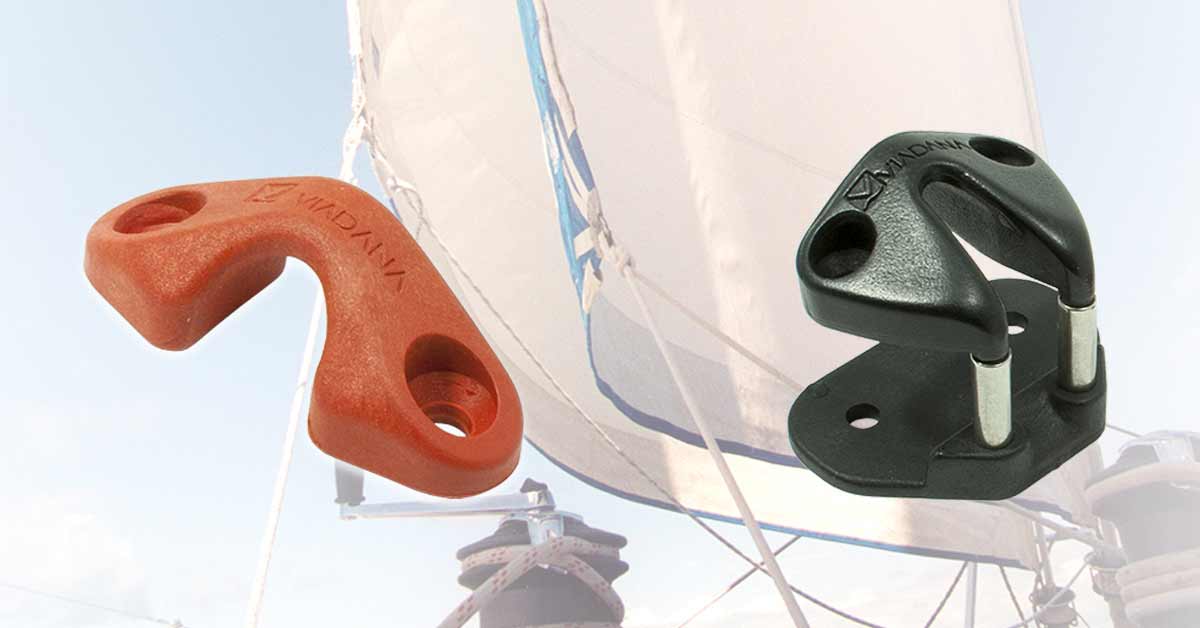
For the rear guide of ball-bearing jaw rope clutches, Viadana has chosen LATILUB 66-20T G/20, a compound developed to combine mechanical resistance, self-lubrication and dimensional stability.
The component, subject to cyclic mechanical stress and high-speed sliding, requires materials capable of withstanding continuous friction without degradation or deformation.
The LATILUB 66-20T G/20 meets these requirements with a formulation based on:
- PA66 (nylon 66) high performance;
- 20% glass fiber, to increase structural rigidity;
- 20% PTFE (polytetrafluoroethylene), to reduce friction and improve wear resistance.
Technical Characteristics of LATILUB 66-20t G/20 Compound
The self-lubricating compound LATILUB 66-20T G/20 offers an optimal balance between tribological properties and mechanical performance, making it ideal for dynamic applications in the marine sector.
| Property | Typical value | Technical benefit |
| Polymer base | PA66 | High thermal and mechanical resistance |
| Reinforcement | 20% glass fiber | Greater rigidity and dimensional stability |
| Lubricating additive | 20% PTFE | Reduction of friction and wear |
| Operating temperature | Up to 110°C | Thermal resistance even in continuous friction |
| Density | 1.42 g/cm³ | Optimal compromise between lightness and strength |
| Coefficient of friction (dry) | <0.25 | Minimal sliding resistance |
| Available colors | Black, yellow, blue, red | Aesthetic customization |
Thanks to the synergy between glass fiber and PTFE, the material ensures structural robustness and permanent lubrication, eliminating the need for greases or oils, often incompatible with saline environments or subject to UV exposure.
Advantages of Self-Lubricating Compounds in Marine Applications
The adoption of self-lubricating technopolymers like LATILUB allows replacing metallic materials in many functional applications, improving the overall system performance.
| Advantage | Description |
| Maintenance-free | Self-lubrication eliminates the need for external lubricants. |
| Corrosion resistance | Ideal for aggressive marine environments. |
| Reduced weight | Up to 70% less than metal. |
| Silent operation | Reduced friction and smooth sliding. |
| Dimensional stability | No deformation under load and temperature. |
| Long-term durability | Consistent performance even after prolonged use cycles. |
These characteristics make the self-lubricating compound for marine applications a strategic choice for designing rope clutches, bushings, slides, pulleys and sliding guides.
Environmental Resistance and Long-Term Reliability
One of the key factors in designing marine components is the combined resistance to mechanical and environmental stress.
The LATILUB 66-20T G/20 maintains its performance even after prolonged exposure to:
- salt water and humidity;
- UV rays and high temperature;
- cyclic mechanical pressures due to sailing maneuvers.
Thanks to the reinforced polyamide base, the material maintains its structural integrity above 100°C, avoiding deformation and performance loss under high thermal conditions.
Conclusions and Invitation to Learn More
The use of self-lubricating compounds for marine applications like LATILUB 66-20T G/20 allows obtaining lightweight, resistant and reliable components even under severe working conditions.
Their ability to resist wear, heat and corrosion makes them ideal for dynamic applications where safety and precision are essential.
Would you like to learn more about self-lubricating technopolymer solutions for marine or industrial applications?
Discover how choosing the right compound can improve performance, durability and sustainability of your projects. Contact us.
FAQ
- What does self-lubricating compound mean?
It is a thermoplastic material with additives such as PTFE or MoS₂ that reduce internal friction, eliminating the need for external lubrication. - Why are self-lubricating compounds suitable for marine applications?
They resist salt spray, humidity and continuous friction, maintaining high mechanical performance even in marine environments. - What components can be made with these materials?
Rope clutches, bushings, sliding guides, pulleys, slides and structural parts subject to friction and dynamic stress.
 Accessibility Statement