

Thermal Management and Safety in LED Systems
The growing adoption of LED lighting technologies has posed new challenges in terms of thermal dissipation and electrical safety.
Despite their high energy efficiency, LEDs generate heat in electronic components and drivers, which must be properly dissipated to ensure longevity, luminous stability, and operational safety.
For this reason, recent years have seen the rise of thermally conductive flame-retardant compounds, capable of combining high thermal conductivity, flame resistance, and injection moldability.
These materials now represent a viable alternative to metal for manufacturing lamp housings, heat sinks, and structural components for LEDs.
LATICONTHER 62 GR/50-V0: High-Performance PA6 Compound
One of the technical benchmarks in this sector is LATICONTHER 62 GR/50-V0, a thermally conductive flame-retardant compound for LED developed with a PA6 base and filled with 50% graphite.
This material is designed to combine high thermal conductivity (≈15 W/m·K) with UL94 V0 certified flame retardancy, without compromising mechanical performance and dimensional stability.
Its main characteristics include:
| Properties | Typical value | Reference Standard |
| Polymer base | PA6 | — |
| Loading | 50% graphite | — |
| Thermal Conductivity | ≈15 W/m·K | ASTM E1461 |
| Flammability Class | UL94 V0 (0.75–3 mm) | UL 94 |
| Glow Wire Flammability Index (GWFI/GWIT) | 960°C at 1.5 mm | IEC 60695-2 |
| Density | ~1.6 g/cm³ | ISO 1183 |
| Operating Temperature | up to 150°C | ISO 75 |
The result is a high-performance thermoplastic compound capable of replacing aluminum or light metal alloys in passive dissipation applications for LED devices, even under natural convection conditions.
Advantages of Thermally Conductive Flame-Retardant Compounds for LED
The use of materials like LATICONTHER 62 GR/50-V0 enables achieving an optimal balance between thermal performance, flame safety, and processing ease.
Among the main technical advantages:
- Efficient thermal dissipation: graphite distributes heat uniformly, preventing localized overheating.
- Certified flame retardancy: V0 flame behavior according to UL94 and GWFI/GWIT at 960°C, ideal for fire-risk environments.
- Reduced weight compared to metals, with equal thermal conduction capacity in natural ventilation conditions.
- High-precision moldability: compatibility with injection molding processes and complex designs.
- Environmental compatibility: free from halogens, red phosphorus, and antimony trioxide.
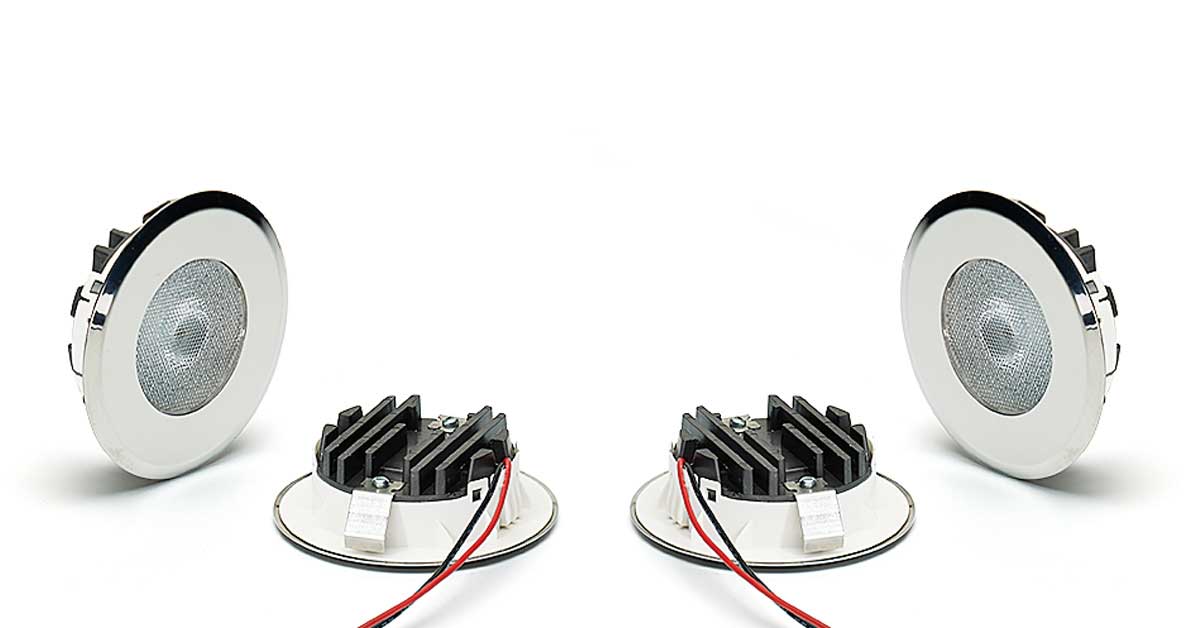
These characteristics make the compound particularly suitable for recessed LED light housings, lighting modules for industrial machines, railway and transport devices, where fire safety is a priority.
Comparison of Thermally Conductive Materials for LED
| Material Type | Thermal Conductivity (W/m·K) | UL94 Class | Relative Weight | Indicative Cost |
| Aluminum | 200 | Non-combustible | 1,0 | Medium |
| Reinforced PPS | 10–12 | V0 | 0,6 | Medium-high |
| PA6 graphite (LATICONTHER 62 GR/50-V0) | ≈15 | V0 | 0,5 | Competitive |
| Ceramic-filled PBT | 4–6 | V0 | 0,6 | Low |
As shown, the thermally conductive flame-retardant PA6 compound offers an excellent performance/weight/cost ratio, ensuring high reliability even in critical applications.
Typical Applications
Thermally conductive flame-retardant compounds are now used in numerous industrial sectors:
- LED lamp housings and heat sinks for civil and industrial use
- Integrated lighting modules in electronic equipment
- Public transport and signaling systems
- Recessed lighting fixtures in furniture and machine tools
- Electronic enclosures and components subject to overheating
The high thermal and mechanical resistance, combined with lightweight and design flexibility, enables significant improvement in LED systems’ thermal efficiency.
Conclusions and Invitation to Learn More
The adoption of a thermally conductive flame-retardant compound for LED like LATICONTHER 62 GR/50-V0 represents an advanced solution for combining thermal management, flame safety, and design sustainability.
This material offers designers a concrete alternative to metals, reducing weight and production complexity without sacrificing performance.
Would you like to learn more about selecting the most suitable thermally conductive compounds for your LED project?
Contact us here!
FAQ
1. What makes a thermally conductive compound suitable for LED applications?
The ability to dissipate heat uniformly and safely while maintaining dimensional stability and electrical insulation.
2. What is the difference between a standard thermally conductive material and a flame-retardant one?
The latter is formulated to self-extinguish, ensuring safety even in case of short circuit or overheating.
3. Can PA6 with graphite replace aluminum in lamp housings?
Yes, in many natural convection applications, thanks to high thermal conductivity and reduced weight.
 Accessibility Statement