

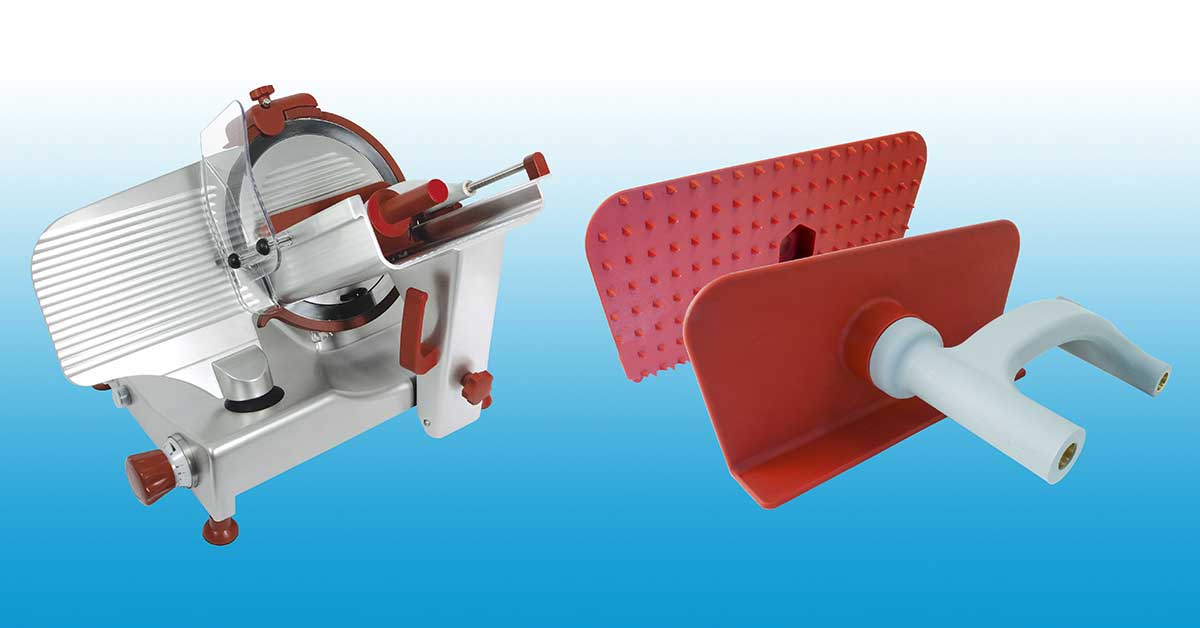
The use of a thermoplastic compound for food contact is revolutionizing the way components for the food industry and professional catering are designed. Thanks to their advanced technical properties, these materials allow the replacement of metals and thermosetting resins in critical applications, ensuring safety, aesthetics and mechanical resistance.
When Thermoplastic Compounds Surpass Metals and Thermosets
The Application Context: Food and Drinking Water
The use of plastics in applications in direct contact with drinking water or food is historically perceived as complex, due to stringent regulatory constraints and hygiene-sanitary requirements. However, advances in reinforced technopolymers have opened new opportunities to replace metals such as aluminum, steel, brass and thermosetting resins, especially in the sectors:
- Professional catering equipment
- Food processing lines
- Cutting and dosing machines
- Visible accessories subject to mechanical stress and frequent cleaning
Technical Advantages of Compounds for Food Use
Thermoplastic compounds for food offer:
- Weight reduction compared to metals (up to -70%)
- Greater resistance to accidental impacts (no denting)
- Good dimensional stability, even in humid environments
- High aesthetics, suitable for visible components
- Compatibility with industrial detergents and sanitizers
- Compliance with main MOCA regulations and, in some cases, NSF51 for extra-EU markets
Case Study: Manconi Professional Slicers and LATIGLOSS Compound
Project Objective
The company Manconi & C. srl (Sumirago – VA), specialized in professional slicers, has introduced a thermoplastic compound for food use in its Smarty machine line, with the purpose of:
- Lightening structural components
- Maintaining aesthetics and hygiene
- Avoiding deformations and dents typical of metals
- Ensuring safety in critical conditions (proximity to blades and mechanical movements)
Components Made in Compound
The following parts, originally in aluminum or thermosetting resin, have been made in LATIGLOSS 66 H2 G/50:
- Blade guard disc
- Product pusher arm
- Complete product pusher
Critical Design Requirements
The components mentioned above must meet severe requirements:
- Dimensional stability even with discs rotating a few mm from the cover
- Mechanical resistance to repeated impacts and compressions
- Cleanability and compatibility with detergent products
- Impeccable aesthetics, being visible parts in continuous use
The Selected Material: Reinforced LATIGLOSS PA66
The chosen compound is a PA66 filled with 50% glass fiber, developed to:
- Mimic the appearance of metal (gloss, perceived solidity)
- Withstand mechanical stress and vibrations
- Be certified for food contact according to NSF51
- Facilitate molding and reduce production complexity
Comparison: Metal vs Food Compound
Characteristic | Metal (Al, steel) | Thermoplastic compound |
Density | 2.7–8.0 g/cm³ | 1.3–1.6 g/cm³ (PA66 GF) |
Impact resistance | medium-high, but sensitive to scratches and dents | high, impact resistant |
Dimensional stability | Excellent | good, if well designed |
Aesthetics | excellent, but degradable with use | excellent, maintained over time |
Food suitability | requires certifications and treatments | certifiable according to NSF, MOCA |
Maintenance | may require polishing, protection | minimal, easy to clean |
Costs | high for finishing and machining | reduced, direct molding |
Guidelines for Choosing a Food Compound
- Verify regulatory compliance (MOCA – EU Reg. 10/2011, NSF/ANSI 51 for export)
- Analyze the usage environment: temperature, humidity, washing agents
- Evaluate functional requirements: mechanical resistance, rigidity, aesthetics
- Choose the suitable polymer matrix: PA66, PPA, PPS, PEEK
- Confirm properties through testing: migration, cleanability, mechanical tests
Do You Want to Replace Metal in Food Applications?
If you are considering the conversion from metal to technopolymer in food components, it is essential to carefully evaluate regulations, design and material selection. I can help you:
- Analyze MOCA or NSF requirements
- Evaluate suitable PA66, PPS or PEEK compounds
- Design high-resistance geometries
- Estimate weight and cost savings
Contact us for personalized technical consulting.
FAQ – Thermoplastic Compound for Food: Frequently Asked Questions
What are the regulatory requirements for a compound for food contact?
It must comply with European MOCA regulations (EU 10/2011 and EC 1935/2004) and, for export, international certifications such as NSF51.
What advantages does a compound have over metal in food applications?
It reduces weight, resists impacts better, is easier to clean and can be molded with complex geometries without the need for mechanical processing.
What is the best compound for a visible food application subject to wear?
PA66 reinforced with glass fiber is often ideal for mechanical resistance, rigidity, aesthetics and food certifiability.
 Accessibility Statement