

Replacing Metal with High-Performance Technopolymers
In the sector of rotary pumps and fluid handling systems, the choice of materials is crucial to ensure efficiency, durability and resistance to aggressive agents.
When contact with hydrocarbons, solvents or corrosive fluids is constant, and operating temperatures reach 200°C, PPS (polyphenylene sulfide) compounds represent the ideal solution to replace metals and other less stable technopolymers.
PPS combines excellent chemical and thermal resistance with dimensional stability and structural rigidity, characteristics that make it a reference material for extreme industrial applications such as compressors, vacuum pumps and fluid transfer systems.
Technical Properties of PPS in Mechanical Components
Reinforced PPS stands out among semicrystalline polymers for its high-level mechanical and dimensional performance, making it an ideal candidate to replace metallic parts even in precision components.
Main Properties of PPS Compounds
| Properties | Typical value | Application benefit |
| Chemical resistance | Excellent against hydrocarbons, solvents and strong acids | No degradation in contact with aggressive fluids |
| Operating temperature | Up to 200°C continuous | Suitable for high-temperature pumps and electric motors |
| Dimensional stability | Reduced shrinkage and minimal deformation | Consistent precision even after repeated thermal cycles |
| Mechanical and fatigue resistance | High even with glass fiber reinforcement | Lasting performance under dynamic loads |
| Creep resistance | Excellent | Maintains tolerances over time |
These characteristics make PPS one of the few polymers capable of operating in prolonged contact with solvents, fuels and inorganic agents, without losing integrity or rigidity.
Real Application: PPS Vanes for Mouvex Rotary Pumps
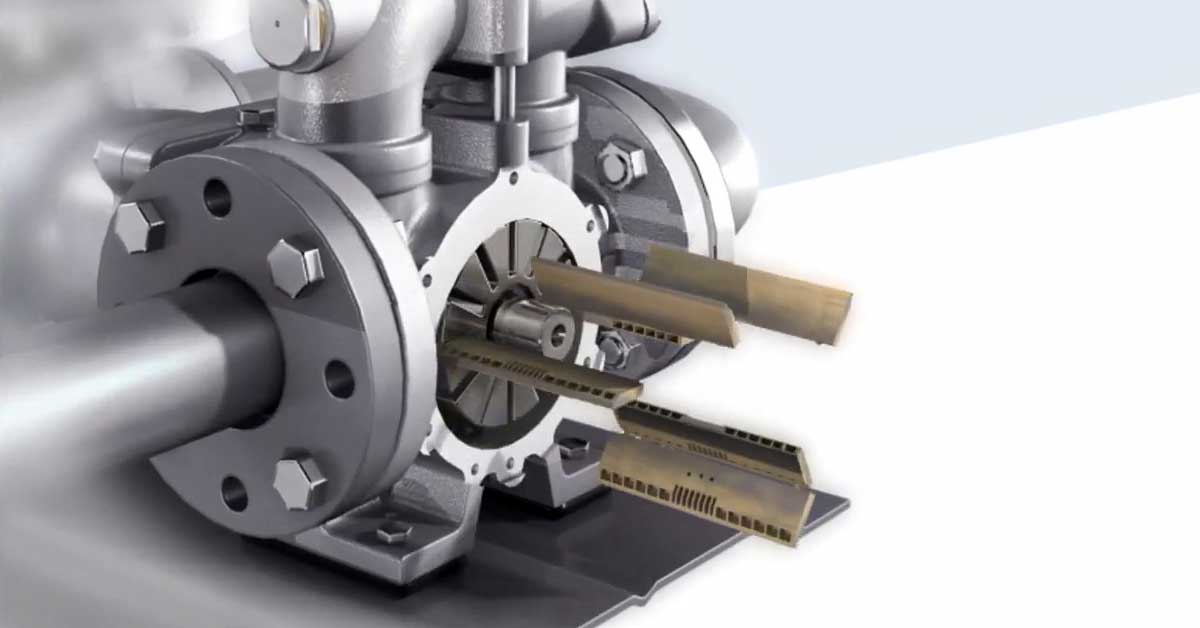
An emblematic example of the effectiveness of PPS compounds for rotary pumps is that of vanes in PPS reinforced with 40% glass fiber, molded by VP Plast and installed on Mouvex pumps, a company of the PSG Dover group, leader in the production of compressors and pumps for industrial fluids.
In rotary vane pumps, these components represent the functional heart of the system.
Their mechanical mission is to maintain perfect sealing between rotor and inner sleeve, ensuring constant flow without leakage. To achieve this, the material must combine:
- high surface hardness to reduce wear,
- self-lubrication and controlled sliding,
- resistance to abrasion and locally elevated temperatures,
- dimensional stability to maintain sealing even after thousands of cycles.
Thanks to these properties, LARTON G/40, LATI PPS compound reinforced with 40% glass fiber, has proven capable of matching or exceeding the performance of metals and PEEK, ensuring reliability and durability over time.
Advantages of PPS Compared to Metallic Materials
Replacing metal with PPS compounds offers tangible advantages in terms of design, efficiency and sustainability:
- Weight reduction up to 70%;
- Elimination of corrosion and oxidation;
- Simplified production processes (injection molding instead of mechanical machining);
- Better electrical and thermal insulation;
- Resistance to thermal shock and aggressive chemical agents.
The result is a lighter, more efficient and durable pump, with lower maintenance requirements and optimized production costs.
PPS LARTON: Complete Range for Industrial Applications
The LARTON family from LATI includes a wide range of PPS compounds developed for different application requirements:
- LARTON G/40 → PPS reinforced with 40% glass fiber: optimal balance between rigidity, strength and dimensional stability.
- Versions with mineral fillers → maximum dimensional precision and reduction of expansion coefficient.
- Carbon fiber reinforced versions → for ATEX antistatic applications and operating conditions with potential electrostatic discharge.
Thanks to these variants, LARTON PPS compounds are ideal for pumps, compressors, valves and components in contact with technical and aggressive fluids.
Conclusion
Discover how PPS compounds for rotary pumps can improve the efficiency, durability and safety of your fluid dynamic systems.
Explore the LARTON range at www.lati.com.
FAQ – PPS Compounds for Rotary Pumps
1. Why choose a PPS compound instead of metal in rotary pumps?
Because PPS resists solvents, hydrocarbons and heat up to 200°C, offering dimensional stability and weight reduction without compromising performance.
2. Which reinforcements improve PPS performance?
Glass and carbon fibers increase rigidity, fatigue resistance and dimensional stability, adapting the material to industrial and ATEX contexts.
3. Is PPS compatible with aggressive or abrasive fluids?
Yes, PPS compounds are designed to operate in highly corrosive and abrasive environments, maintaining integrity and reliability over the long term.
 Accessibility Statement