

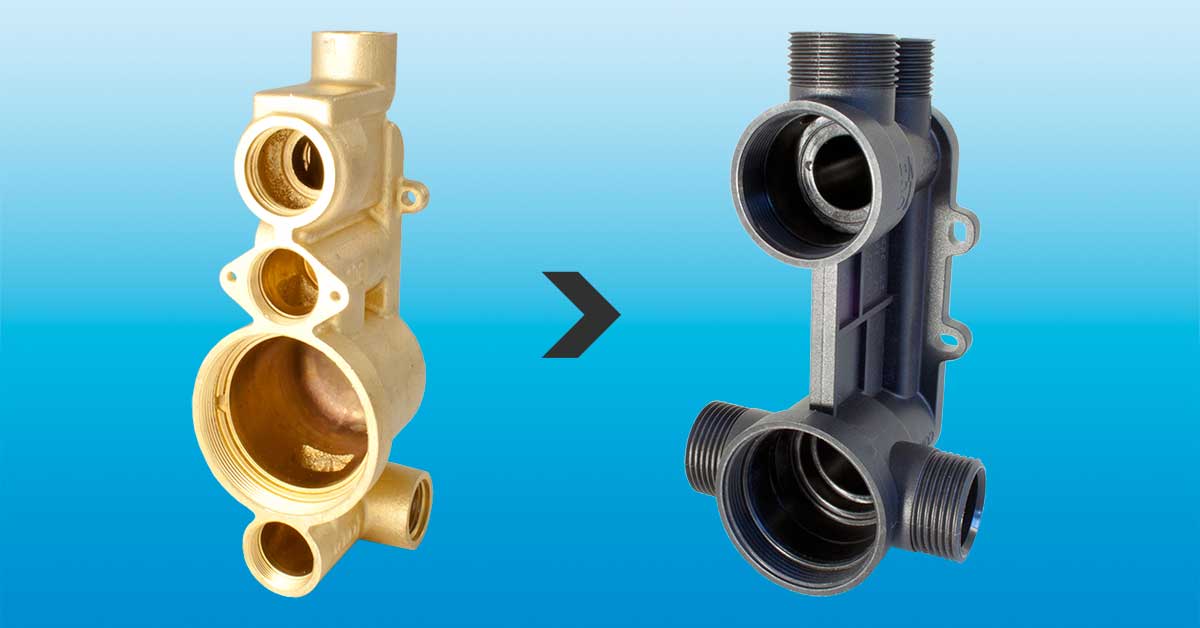
The replacement of metal with thermoplastic compounds (metal replacement with engineering polymers) is a fundamental strategy in many industrial applications that aim to reduce weight, costs and complexity. However, the transition is not trivial: it requires a new design mindset, a deep understanding of compound properties and a careful study of application limitations.
In the following case, a technical case study is presented: Ultra Finishing & CPA Products that replaced brass components with LATIGLOSS compound in the construction of a thermostatic shower valve.
Intrinsic Challenges in Metal Replacement
Material Differences to Consider
When transitioning from metal to a thermoplastic compound, constraints arising from intrinsic differences must be considered:
- Elastic modulus and stiffness: thermoplastics, even reinforced ones, have lower moduli than metallic ones, so the part must be redesigned (thicknesses, ribs, geometries) to compensate for flexibility.
- Creep and slow deformations: under constant loads, polymeric materials can deform over time; these phenomena must be considered in dimensioning.
- Thermal performance and dimensional stability: compounds must withstand temperature variations, expansion, contraction and moisture absorption.
- Material processability: high percentages of fiber and additives can make flow in the mold difficult and generate defects.
- Compatibility with the operating environment (humidity, chemical agents, corrosion) and required durability.
Many industry studies indicate that it is not possible to directly replace a metal component with an equivalent compound without structural redesign: rounded corners, use of FEM software and recalculation of thicknesses are standard practices in metal replacement.
Case Study: “Pioneer” Thermostatic Valve in LATIGLOSS
Project Context and Objectives
Ultra Finishing Ltd, in collaboration with CPA Products, undertook a project to remove brass from some components of its shower valve line and replace them with a technical thermoplastic compound: LATIGLOSS.
The main objectives were:
- Overall weight reduction of the component.
- Cost reduction, both in material and process (fewer finishes and mechanical operations).
- Size optimization and component integration.
- Maintenance of tight tolerances without the need for post-molding operations.
Development Strategy and Timeline
- CPA designed tooling and developed geometries that reduced the number of components in the valve assembly.
- Reinforcement elements and optimized geometries (ribs, differentiated thicknesses) were adopted to withstand hydraulic and mechanical stresses.
- The transformation cycle from concept to production lasted eight months, including co-design, prototyping and implementation phases.
Results Achieved
- The component weight was reduced to almost one-tenth compared to the brass equivalent.
- The valve produces high dimensional stability despite the high glass fiber content, thanks to good flow design and studied geometry.
- All internal tests (pressure, leaks, durability) were successfully passed, confirming the robustness of the polymeric solution.
- The material is not subject to corrosion like metals, improving durability in aqueous environments.
This case is also cited by LATI in its portfolio to illustrate how compounds can replace metallic components in real applications.
Guidelines for Designing Metal Replacement with Compounds
1. Analysis of functional and environmental requirements
- Identify loads (static, dynamic, cyclic).
- Evaluate operating temperatures, thermal excursions, humidity and chemical aggressiveness.
- Define deformation limits and acceptable tolerances.
2. Compound selection and reinforcement grade
- Choose a suitable polymeric matrix (PA6, PA66, PPA, PPO, PPS)
- Define the glass fiber percentage (e.g. 30–65%) based on the flow/mechanical compromise.
- Consider additives for thermal stabilization, UV resistance, internal lubrication, etc.
3. Rethink geometry (redesign)
- Increase thicknesses where necessary, add ribs and localized reinforcements.
- Avoid sharp corners and discontinuities that favor stress concentrations.
- Use CAE/FEM software to simulate mechanical and thermal behavior of reinforced material. LATI offers simulation services for metal replacement.
4. Process control and molding parameters
- Optimize flow to handle highly loaded material.
- Control shrinkage and deformations during cooling.
- Integrate dimensional controls in production and quality monitoring.
5. Experimental verification and validation cycle
- Perform tensile, flexural, creep, fatigue tests.
- Pressure, leak and durability tests for fluidic components.
- Verify environmental resistance over time (humidity, chemical agents).
- Validate batches with field tests before industrial launch.
Main Advantages and Limitations to Consider
Advantages
- Significant weight reduction: compounds have much lower densities compared to metals (e.g. typical densities of PA + glass compounds ~ 1.5–2.0 g/cm³ vs 7–8 g/cm³ for metal).
- Greater design freedom and function integration, thanks to molding.
- Lower post-processing costs, fewer finishes, less assembly.
- Improved corrosion and chemical resistance compared to metals in aggressive environments.
- Sustainability potential: reduction in energy consumption, simplification in recycling, LCA (life cycle assessment) optimization.
- Various compounding and technology providers today offer customizable material for metal replacement.
Limitations and Considerations
- Not all metallic applications are replaceable — in cases of high temperatures, extreme stresses or specific conductivity requirements, a hybrid may be necessary.
- Redesign is mandatory: you cannot replace “in toto” without redesign.
- The investment in simulation, prototyping and validation is higher compared to a simple replacement.
- For low volumes, the compound cost may be higher compared to established metallic solutions.
- Tight tolerances and complex geometries require high experience.
FAQ
Q1: When is it convenient to use metal replacement with thermoplastic compounds?
When requirements (load, temperature, deformations) are compatible with reinforced polymers, and you can benefit from lightness, costs, integrated design and sustainability.
Q2: What reinforcement grades are typical in compounds for metal replacement?
Glass fibers in the 30-65% by weight range are commonly used to achieve a compromise between mechanics and processability. Studies show that even compounds with 50% glass fiber can have excellent strength-to-weight ratio.
Q3: What are the most frequent design errors?
The most common include using geometries designed for metal without adaptation (sharp corners, insufficient thicknesses), ignoring creep or long-term deformation, and not considering the anisotropy of reinforced material.
 Accessibility Statement