

Aesthetics and Resistance in Structural Technopolymers
In the world of advanced technopolymers, the compromise between mechanical resistance and aesthetic quality has always represented a design challenge.
Structural materials reinforced with glass or carbon fibers offer excellent mechanical performance, but often compromise surface appearance, making them unsuitable for applications where functionality and design must coexist.
To address this need, LATIGLOSS aesthetic structural compounds were developed, designed to combine high resistance and premium surface finish.
This family of materials opens new possibilities for metal replacement, enabling the production of components that are robust, lightweight and visually impeccable.
LATIGLOSS: Technology and Performance of Aesthetic Structural Compound
LATIGLOSS compounds are based on PA66 reinforced with 50% glass fiber, a high-performance semicrystalline polymer that offers optimal balance between rigidity, dimensional stability and thermal resistance.
The true innovation lies in the surface finish, perfectly smooth and uniform, even on complex components or those with variable thickness.
Main Technical Properties
| Property | Typical value | Description |
| Polymer matrix | PA66 50% reinforced | High rigidity and thermal stability |
| Elastic modulus | > 12,000 MPa | High flexural resistance |
| Tensile strength | > 2,000 kg/cm² | Mechanical performance comparable to metals |
| Surface appearance | Glossy and uniform | Even on complex geometries and bright colors |
| Chemical resistance | Excellent | Suitable for contact with detergents and disinfectants |
Thanks to its formulation, LATIGLOSS enables the production of technical components with high aesthetic quality without painting, reducing costs and environmental impact related to surface treatments.
Application Case: Metal Replacement in Veterinary Instruments
A concrete example of the effectiveness of aesthetic structural compounds for technopolymers is represented by the application developed for the French company Chevillot, leader in the production of instruments for livestock animal identification.
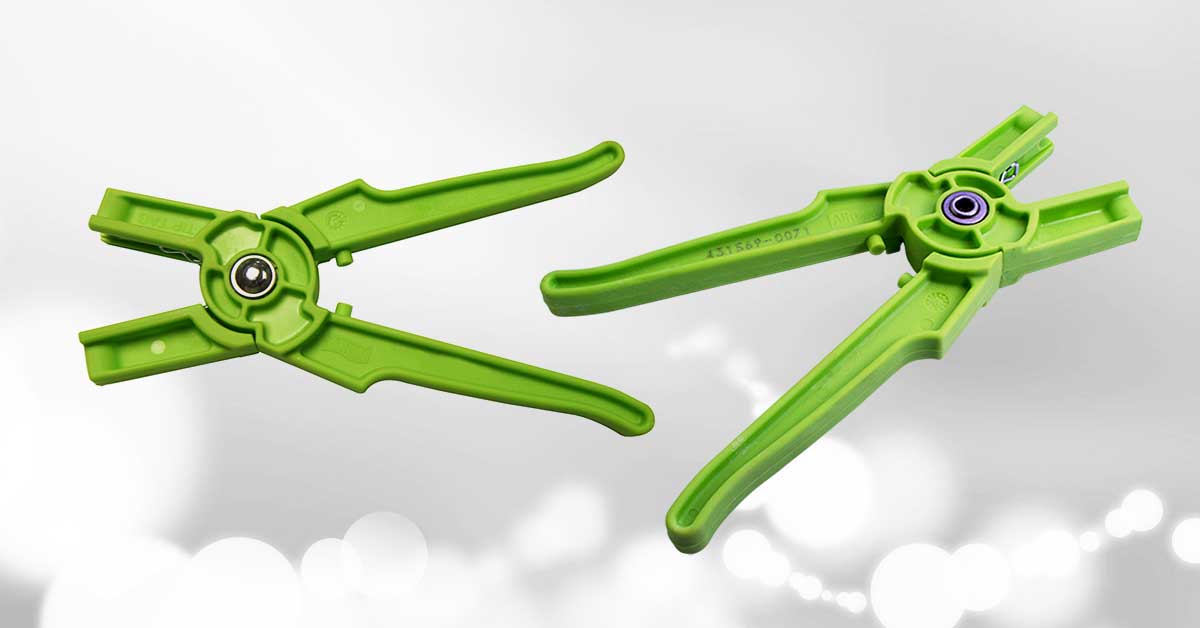
The company chose LATIGLOSS to produce new veterinary pliers for ear tag application, replacing traditional painted metal versions.
Reasons for the Choice
- Weight reduction: technopolymer pliers are lighter, facilitating prolonged use;
- Mechanical resistance equivalent to metallic versions;
- Superior aesthetic finish, even in bright colors resistant to wear;
- Easy cleaning and disinfection, thanks to the high chemical resistance of the material;
- Absence of corrosion and greater operational hygiene.
Injection molding production, entrusted to Alpha Industrie Plastique, enabled obtaining optimized geometry with robust and precise arms, maintaining excellent dimensional stability even after numerous use cycles.
Advantages of Aesthetic Structural Compounds in Technopolymers
The introduction of aesthetic structural compounds like LATIGLOSS marks a turning point for technical component designers.
Among the main benefits:
- Integration of function and form: mechanical resistance and aesthetic finish in a single material;
- Elimination of painting → lower costs and environmental impact;
- Compatibility with complex geometries and variable thicknesses;
- Possibility to replace metals in industrial, medical and design applications;
- Resistance to chemical and atmospheric agents, ideal for aggressive or high-hygiene environments.
Thanks to these characteristics, LATIGLOSS compounds find application also in medical instrumentation, automotive components, precision devices and technical consumer articles.
Conclusion
Discover the potential of aesthetic structural compounds for technopolymers like LATIGLOSS: high-performance materials for applications where mechanics and design meet.
Learn more at www.lati.com.
FAQ – Aesthetic Structural Compound for Technopolymers
- What distinguishes an aesthetic structural compound from a standard technopolymer?
The ability to offer high mechanical resistance with a smooth and uniform surface appearance, without the need for aesthetic treatments. - In which sectors are LATIGLOSS compounds used?
They are used in fields such as medical, industrial, automotive and technical instruments, wherever performance and aesthetic quality are required. - Can LATIGLOSS replace metallic components?
Yes, thanks to its rigidity and resistance, it is ideal for replacing metal in many applications, reducing weight and costs.
 Accessibility Statement