

Advanced Materials for Safety and Energy Efficiency
In the HVAC (Heating, Ventilation and Air Conditioning) sector, the pursuit of greater living comfort and reduced energy consumption is a constant goal.
The condensing boilers, now standard in many residential and industrial systems, represent one of the most efficient heating solutions, as they recover latent heat from exhaust gases, minimizing energy losses.
To ensure the operational safety and maximum reliability of these systems, it is essential to use materials capable of preventing electrostatic charge accumulation and withstanding the thermal and chemical conditions typical of the operating environment.
In this context, LATIOHM electrically conductive compounds are successfully employed by Wolf GmbH, a leading German company in heating and air conditioning technologies.
Wolf GmbH and LATI: Conductivity and Reliability in Air-Gas Sleeves
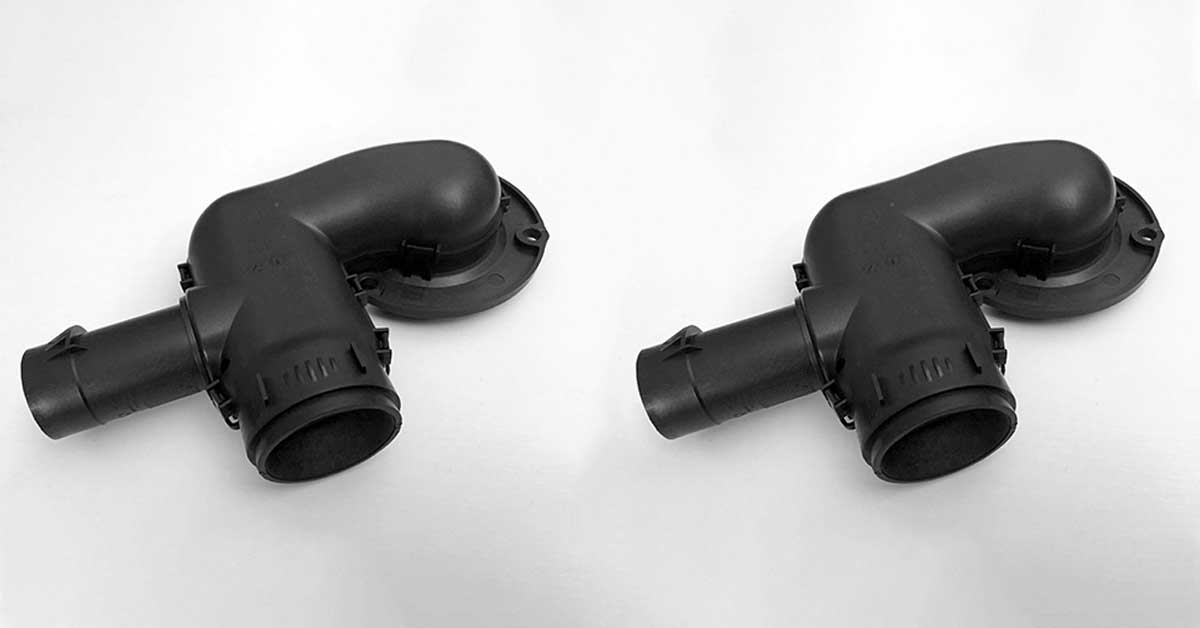
For its condensing boilers, Wolf has chosen a LATIOHM 66-07 PD08 G/30 conductive compound for the production of sleeves that manage the air-gas mixture.
This component plays a crucial role in maintaining the electrical and functional safety of the system, where it is necessary to dissipate any electrostatic charges that could compromise proper operation or generate dangerous discharges.
The selected material meets the most stringent industry requirements:
- Controlled electrical conductivity, with stable resistivity thanks to calibrated carbon fibers and conductive additives.
- High mechanical strength (>100 MPa) even at 90°C, thanks to the combined reinforcement with glass and carbon.
- Chemical inertia towards gases, condensates, and agents present in the air-gas system.
- Exceptional dimensional stability, essential for the sealing of joints and compatibility with other plastic and metal components.
- UL certification with RTI, certifying its thermal resistance and long-term reliability even for the US market.
Technical Properties of LATIOHM 66-07 PD08 G/30
|
Properties |
Indicative value |
Benefit |
|
Surface resistivity |
10²–10⁴ Ω |
Safe dissipation of electrostatic charges |
|
Tensile strength |
>100 MPa |
Structural robustness |
|
Continuous operating temperature |
90°C |
Thermal stability |
|
Reinforcing charges |
Glass + carbon fibers |
High rigidity and durability |
|
Certification |
UL RTI |
Compliant with international standards |
Thanks to this combination of properties, the electrically conductive compound ensures homogeneous charge dissipation and mechanical resistance over time, two fundamental requirements for applications in gas boilers and next-generation HVAC systems.
Advantages of Using LATIOHM Conductive Compounds
The LATIOHM electrically conductive compounds represent a valid alternative to metals or traditional materials, offering significant technical and production advantages:
- Weight reduction of components by up to 60%.
- Elimination of electrostatic accumulation risks thanks to intrinsic conductivity.
- Processability through injection molding, ideal for precision and high-volume productions.
- Superior chemical and thermal resistance compared to common standard polymers.
- Compatibility with international regulations (UL, RoHS, REACH).
These performances make LATIOHM compounds perfect for fittings, connectors, supports, and air-gas distribution systems, where electrical safety meets environmental resistance.
LATIOHM Compounds: a Complete Range for Conductivity Management
The LATIOHM line includes materials formulated on various polymer bases (PA6, PA66, PBT, PPS, POM, PPA) and with different conductivity levels:
- Antistatic (resistivity 10⁶–10⁹ Ω): for applications sensitive to ESD discharges.
- Dissipative (10³–10⁶ Ω): for electronic components and functional surfaces.
- Conductive (<10³ Ω): for HVAC systems, pumps, tanks, or valves in controlled atmospheres.
- Carbon nanotubes (CNT) for maximum conductive efficiency with minimal filler load.
Learn more
Discover the LATIOHM range of electrically conductive compounds for condensing boilers and HVAC systems.
Explore the technical solutions at www.lati.com or request an application analysis for your project.
FAQ – Electrically Conductive Compound for Condensing Boilers
- Why is a conductive compound needed in condensing boilers?
To prevent the accumulation of electrostatic charges that could interfere with sensors, valves, and air-gas control systems. - What advantages does it offer compared to metal?
Reduced weight, chemical and thermal resistance, controlled electrical insulation, and the ability to mold into complex shapes. - Is the LATIOHM compound compliant with international standards?
Yes, LATIOHM grades are UL certified with RTI and compliant with RoHS and REACH regulations.
 Accessibility Statement