

Electrostatic Management in Hydrocarbon Tanks
Fuel tanker trucks for transporting gasoline or diesel must meet strict electrical safety standards.
During loading, unloading, or movement, liquid friction can generate potentially dangerous electrostatic charges.
To prevent electrical potential buildup and ignition risk, it is essential that every component in contact with fluids is electrically conductive.
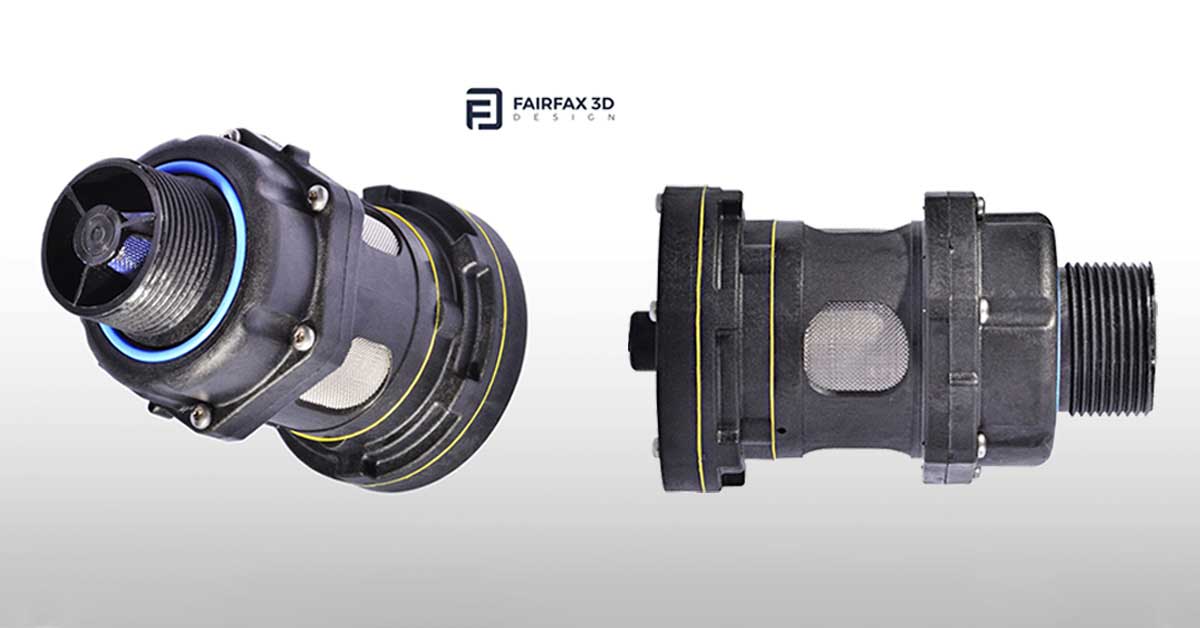
This is the context for the solution developed by Fairfax 3D Design, a British company specializing in advanced design, which has chosen LATIOHM conductive compounds for manufacturing their tank vent valves.
Vent Valves in Conductive Compound: the Fairfax 3d Design Case
Fairfax 3D valves are designed to regulate overpressure and vacuum inside tanker compartments.
Each tank can include up to seven adjacent sections, for a total of over 40,000 liters of fuel.
Under these conditions, electrical continuity between all structural and functional elements is fundamental for safety.
Fairfax 3D has identified LATIOHM electrically conductive compounds as an ideal solution to ensure:
- High electrical conductivity for static charge dissipation;
- Chemical resistance, necessary for contact with hydrocarbons and vapors;
- Dimensional and mechanical stability, even under loads and vibrations;
- Overall weight reduction compared to metals, with logistical and economic benefits.
LATIOHM 66-07 PD08 G/30 Compound: Composition and Performance
The material chosen for the valves is LATIOHM 66-07 PD08 G/30, a reinforced and conductive PA66-based compound, developed for industrial and safety applications.
Main technical characteristics
| Property | Typical Value | Technical Benefit |
| Matrix | PA66 | Excellent mechanical and thermal resistance |
| Structural reinforcement | 30% glass fiber | Rigidity and dimensional stability |
| Conductive filler | Selected carbon fiber | Controlled electrical conductivity |
| Surface resistivity | ~1 × 10³ Ω | Safe static charge dissipation |
| Chemical resistance | High | Compatibility with hydrocarbons and additives |
| Density | <1.5 g/cm³ | Lower weight than metals, load reduction |
Thanks to this composition, LATIOHM 66-07 PD08 G/30 offers an optimal balance between electrical, mechanical, and processing performance.
The material can be injection molded with standard machines, without requiring specific equipment.
Advantages of Electrically Conductive Compound for Tanks
The use of conductive compounds in tank safety systems offers concrete advantages over traditional materials:
| Aspect | Metallic material | LATIOHM compound |
| Weight | High | Reduced (–50%) |
| Electrical conductivity | Excellent | Optimal, controllable |
| Chemical resistance | Limited (corrosion) | High, intrinsic |
| Workability | Mechanical processing | Direct molding |
| Production cost | High | Lower, with rapid cycles |
| Maintenance | Requires protective coatings | No protection needed |
These materials are therefore ideal for valves, fittings, and functional components intended for tanks, tanker trucks, and fuel storage facilities, where controlled electrical conduction and high durability are required.
Safety and Reliability in ATEX Environments
Applications in explosion-risk zones (ATEX) require materials that comply with electrostatic dissipation regulations.
The electrically conductive compound for tanks must maintain a surface resistivity below 10⁶ Ω, preventing charge accumulation even in low humidity conditions.
LATIOHM 66-07 PD08 G/30 fully meets these requirements, ensuring:
- Performance stability over time,
- Compatibility with industrial molding processes,
- Uniform conductivity on complex surfaces.
Learn more
Learn more about LATIOHM electrically conductive compounds for manufacturing safety components for tanks, containers, and industrial facilities at www.lati.com.
FAQ – Electrically Conductive Compound for Tanks
- Why is electrical conductivity important in fuel tanks?
It prevents the accumulation of static charges which, in the presence of flammable vapors, could cause discharges or fires. - What is the ideal resistivity of a material for these applications?
Generally below 10⁶ Ohm, with optimal values around 10³–10⁴ Ohm to ensure controlled dissipation. - Can LATIOHM compounds replace metal in tank valves?
Yes, they maintain high mechanical and chemical resistance, offering superior lightness and electrical safety.
 Accessibility Statement