

Managing electrostatic charges represents a crucial challenge in all industrial environments subject to explosion risks.
In these contexts, the adoption of electroconductive compounds compliant with ATEX Directive 2014/34/EU is essential to prevent the accumulation of dangerous electrical potentials and ensure the safety of people, machinery, and electronic equipment.
Risks and Requirements of ATEX Applications
When static charges of thousands of volts accumulate, the risk of sudden discharges can be devastating in the presence of explosive atmospheres or flammable substances.
For this reason, all structures and components operating in ATEX zones must ensure proper grounding and effective control of electrical resistivity.
However, traditional plastic materials — being naturally electrical insulators — impede charge dissipation, promoting the accumulation of localized electrical potentials.
In such cases, it is necessary to use electroconductive compounds, namely polymers modified with conductive additives capable of safely dissipating static charges.
LATIOHM: LATI’s Solution for Antistatic Safety
The LATIOHM electroconductive compound family was created to definitively solve issues related to electrical conductivity in thermoplastic materials.
Thanks to the use of conductive additives based on carbon fiber or conductive black, these materials ensure:
- surface and volume resistivity well below the limits imposed by the ATEX directive;
- constant electrical stability over time;
- preservation of mechanical and structural performance of the polymer matrix.
In ATEX applications, these compounds allow controlled dissipation of electrostatic charges, avoiding the risk of sparks and localized discharges.
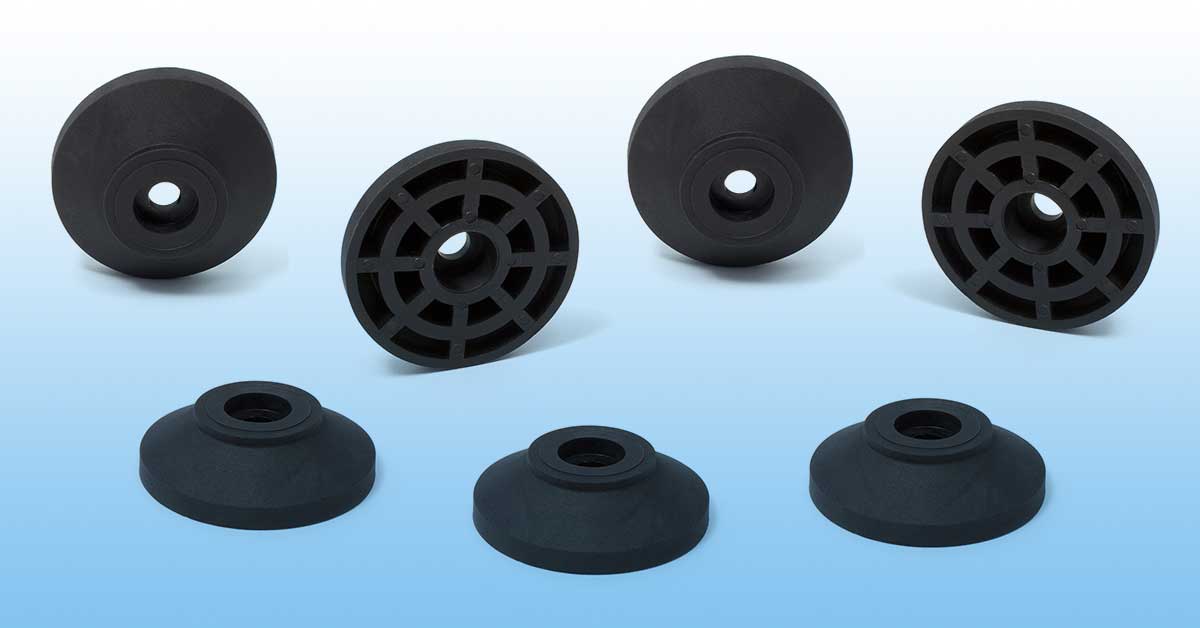
Application Case: Leveling Feet in LATIOHM 62-03 PD01 G/20
A concrete example of LATIOHM compounds usage comes from Plastijet, a company specialized in manufacturing technical components for industrial machinery.
Technical Specifications of the Material
The selected material, LATIOHM 62-03 PD01 G/20, is a PA6-based compound formulated with carbon fiber to ensure electrical conductivity and glass fiber for mechanical reinforcement.
This combination enables excellent mechanical and antistatic properties.
| Property | Typical Value | Function |
| Surface resistivity | 10³–10⁶ Ω | Controlled static charge dissipation |
| Elastic modulus | > 7000 MPa | Rigidity and dimensional stability |
| Creep resistance | High | Load maintenance over time |
| Fatigue resistance | High | Durability under vibration |
| Polymer base | PA6 | Lightness and processability |
The final component — leveling feet for industrial machinery — must ensure constant grounding, structural robustness, and resistance to vibrations and static loads over the long term.
Mechanical Performance and Integrated Safety
LATIOHM 62-03 PD01 G/20 not only ensures controlled electrical conduction but also offers excellent mechanical characteristics:
- resistance to continuous static load, without creep deformation;
- resistance to impacts and vibrations, typical of moving industrial machinery;
- dimensional stability even under thermal or environmental stress.
The combination of glass fiber and carbon fiber ensures an optimal balance between antistatic function and mechanical strength, avoiding the use of metals and reducing the overall component weight.
Compliance and Versatility of LATIOHM Compounds
All materials in the
- ATEX Directive 2014/34/EU
- RoHS (Restriction of Hazardous Substances)
- REACH and SVHC (Substances of Very High Concern)
The range includes versions based on PA, PBT, PPS, PPA and PC-ABS, capable of meeting various thermal and mechanical requirements, from structural applications to sensitive electronic components.
Main Advantages of LATIOHM Electroconductive Compounds
| Advantage | Description |
| ATEX compliance | Controlled resistivity for safety in potentially explosive environments |
| High mechanical strength | Ideal for structural components subject to loads and vibrations |
| Standard processability | Injection molding with parameters similar to traditional techno-polymers |
| Reduced weight | Alternative to metals for reducing costs and overall mass |
| Quality aesthetics | Excellent surface finish even in technical applications |
FAQ – Frequently Asked Questions about Electroconductive Compounds for ATEX Applications
- What is an ATEX electroconductive compound?
It is a polymeric material modified with conductive additives that reduce electrical resistivity, allowing safe dissipation of static charges, as required by ATEX regulations. - In which sectors are LATIOHM compounds used?
They are used in industrial plants, electrical equipment, automation, transportation, and packaging, where antistatic protection or grounding is required. - Can they replace metal components?
Yes, thanks to glass and carbon fiber reinforcement, LATIOHM compounds offer strength and lightness, making them suitable as a structural alternative to metals in many ATEX applications.
Conclusion
The electroconductive compounds for ATEX applications, such as LATIOHM 62-03 PD01 G/20, represent a safe, lightweight, and high-performance solution to ensure antistatic protection and structural strength.
They are the ideal choice for those seeking materials that combine safety, design, and industrial productivity.
Would you like to evaluate a LATIOHM compound for your ATEX applications?
Request a personalized technical consultation to identify the most suitable formulation for your project.
 Accessibility Statement