

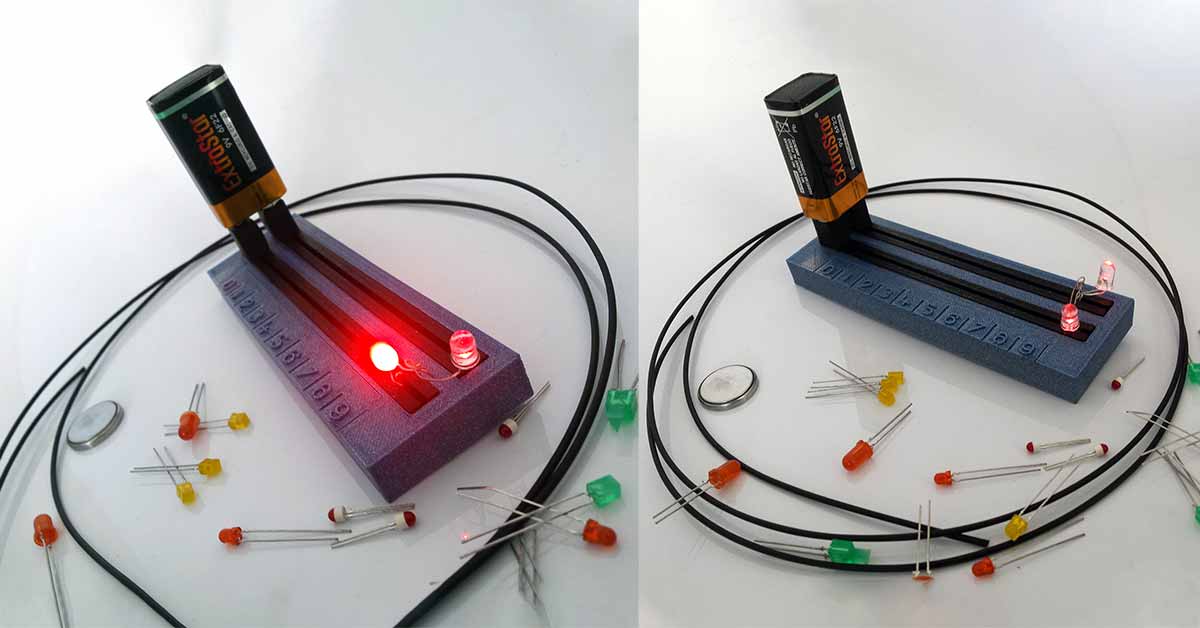
3D printing of functional components is no longer just a design exercise, but an advanced tool for electronic prototyping, embedded sensors, and custom printed circuits. Electroconductive filament for 3D printing fits into this context as a new class of materials capable of transferring electrical signals and creating conductive paths directly through FFF (fused filament fabrication).
Through the collaboration between LATI and FiloAlfa, a joint project has been created to develop 3D printable conductive compounds, accessible to both industry and the maker and research community.
What is an Electroconductive Filament and why it Matters
Definition and Functionality
An electroconductive filament is a thermoplastic material modified to allow electrical current flow. Electrical conductivity is achieved by loading the polymer matrix (PLA, ABS, PETg…) with carbon nanotubes, graphene, metal powders, or other functional additives.
These filaments:
- conduct small electrical signals (low voltage)
- can be printed on any standard FDM printer
- are suitable for creating conductive tracks, sensors, contacts, antennas, or connectors
LATI’s Proposal: Technical Compounds Based on PLA
The first material developed by LATI is a modified PLA compound with carbon nanotubes, capable of combining:
- good 3D printability (dimensional stability, controlled shrinkage, bed adhesion)
- sustainability (PLA from renewable sources)
- non-ohmic electrical conductivity with typical resistivity ≈ 10 Ω·cm
These characteristics make the filament suitable for producing conductive tracks on free-form geometries, allowing to integrate electrical functions directly into the printed component.
Applications of Electroconductive Filament
The application potential is broad and continuously evolving:
| Sector | Application Examples |
| Medical | Pressure sensors, biofeedback, smart patches |
| Electronics | Printed connectors, signal traces, antennas |
| Automation | Embedded sensors, soft actuators, flexible contacts |
| Education and Makers | Functional prototypes, interactive objects, wearable tech |
Thanks to controlled resistance, it’s possible to modulate signal intensity, simulate resistive behaviors, and even evaluate touch or piezoresistive functionalities.
Technical Advantages of Conductive Filaments Compared to Traditional Systems
| Feature | Conductive Filaments | Traditional Systems |
| Printability | High (on standard FDM) | Requires PCB or substrates |
| Geometries | Free-form, 3D | 2D or planarized |
| Prototype costs | Low | High |
| Integration | Direct in part | Externalized |
| Recyclability | Partial (matrix dependent) | Limited |
Current Challenges and Future Developments
Despite the advantages, some critical issues are still under study:
- Low conductivity compared to metals → limitation for high currents
- Non-linear electrical behavior → requires calibration
- Interaction with humidity and temperature → needs evaluation in critical environments
However, the evolution of functional nanomaterials, optimization of filler dispersion, and integration with new multi-material technologies (co-printing, overmolding) pave the way for superior performance.
FAQ – Frequently Asked Questions about Electroconductive Filament for 3d Printing
- Is the conductive filament compatible with all 3D printers?
Yes, if PLA-based or similar, it can be used on any FDM printer with nozzles ≥ 0.4 mm. - Can it replace electrical wires?
No, it is suitable for low-intensity signals or contacts, not for high current transmission. - How do you test the conductivity of the printed part?
You can measure the resistance of the printed path between two points using a multimeter.
Contact Us
If you’re looking for a material to integrate electrical functions in 3D printing, the electroconductive filament can open new design opportunities. Contact us to learn more.
 Accessibility Statement