

The replacement of metallic and thermoset components with flame-retardant thermoplastic compounds is an increasingly common strategy in the mechanical, electrical, and electrotechnical industries.
Among the leading materials in this field is LATAMID 66 H2 G/50-V0HF1, a reinforced polyamide-based compound developed to combine structural robustness, fire safety, and environmental sustainability.
Technical Performance of LATAMID 66 H2 G/50-V0hf1
This compound represents an advanced technical solution for applications requiring high mechanical strength, thermal stability, and certified flame retardancy simultaneously.
It is particularly suitable for structural components of motors, generators, and electrical transfer systems, where it must ensure stable performance even beyond 100°C.
Application Example: Brush Holders for Electric Motors
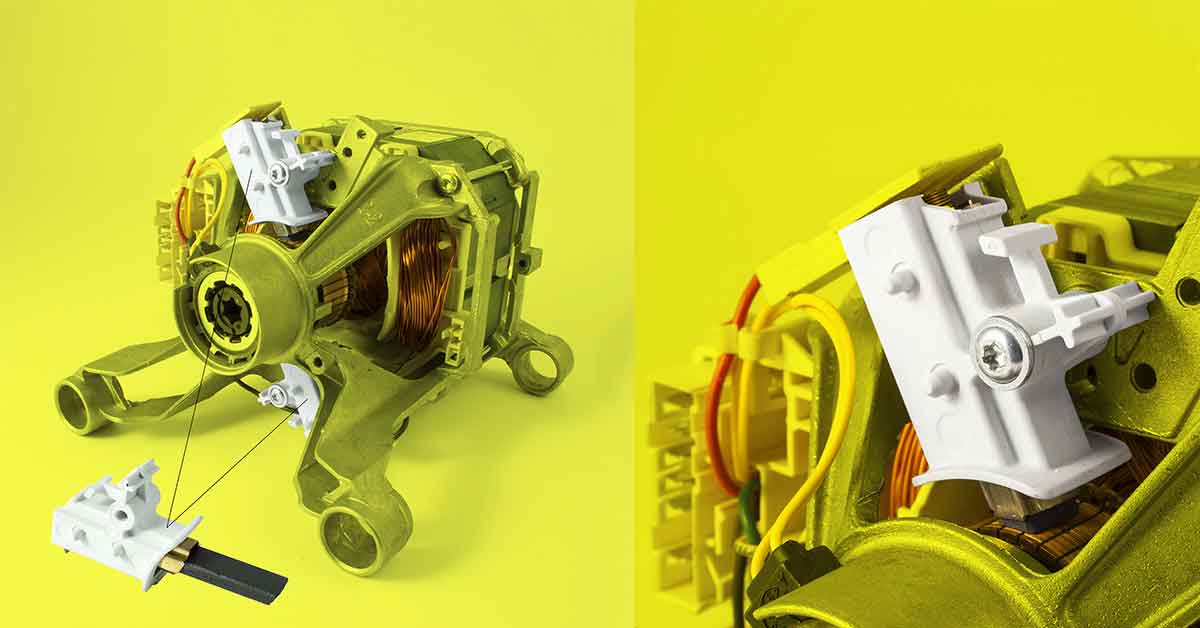
The company SELNI, specializing in current transmission systems, has adopted LATAMID 66 H2 G/50-V0HF1 for the production of brush arms used in motors and generators.
The component must maintain a stable and constant contact between the graphite electrode and the conductive elements, ensuring mechanical precision, dimensional stability, and thermal resistance.
|
Properties |
Typical value |
Technical function |
|
Polymer base |
PA66 |
Excellent balance between stiffness and thermal resistance |
|
Reinforcement |
50% glass fiber |
Dimensional stability and mechanical robustness |
|
Flame retardancy |
UL94 V0 (0.75–3 mm) |
Certified safety against flame ignition |
|
Creepage resistance (CTI) |
600 V |
Protection from electrical arcs and tracking |
|
Operating temperature range |
>100°C |
Reliability in critical operating conditions |
|
Environmental compliance |
RoHS – Halogen-free and red phosphorus-free |
Safety and sustainability |
Flame Retardancy and Certified Safety
One of the most significant aspects of LATAMID 66 H2 G/50-V0HF1 is its intrinsic flame retardancy.
The HF1 formulation uses halogen-free and red phosphorus-free flame retardant systems, reducing the formation of toxic and corrosive compounds.
This allows achieving a UL94 V0 flammability class while maintaining excellent mechanical and thermal characteristics, unlike traditional materials that often sacrifice structural performance to achieve the same classification.
Advantages over Metals and Thermosets
The use of flame-retardant compounds for metal replacement offers tangible advantages in terms of design, safety, and sustainability:
|
Aspect |
Metals / Thermosets |
LATAMID V0HF1 Compound |
|
Specific weight |
High |
Up to 50% lighter |
|
Recyclability |
Limited (thermosets not recyclable) |
Fully recyclable |
|
Workability |
Complex machining and assembly |
Direct injection molding |
|
Flame retardancy |
Requires treatments or coatings |
Intrinsic (UL94 V0) |
|
Environmental Sustainability |
Often containing harmful additives |
RoHS compliant, halogen-free and red phosphorus-free |
These characteristics make LATAMID 66 H2 G/50-V0HF1 a valid alternative to brass, aluminum, and thermoset resins, allowing for simplified production and improved performance of the finished product.
Dimensional Stability and Processability
The material is easy to injection mold, with controlled and homogeneous shrinkage, ensuring precise geometric tolerances even in complex components.
The creep and fatigue resistance ensures a long component life, even under dynamic stress or vibrations.
Sustainability and Environmental Compliance
The HF1 formulation meets the most stringent international regulations on environment and health:
- Compliant with RoHS and REACH;
- Free of halogens and red phosphorus;
- Recyclable and low environmental impact;
- Compatible with standard industrial production processes.
LATI HF1 Range: Variants and Performance
The LATAMID V0HF1 family includes various versions reinforced with glass fiber from 25% to 50%, all UL94 certified and designed for electrical, electronic, and mechanical applications where flame retardancy and structural integrity are required.
|
Version |
Reinforcement |
Typical application |
|
LATAMID 66 H2 G/25-V0HF1 |
25% glass |
Light electrical components |
|
LATAMID 66 H2 G/35-V0HF1 |
35% glass |
Connectors, structural supports |
|
LATAMID 66 H2 G/50-V0HF1 |
50% glass |
Structural parts and metal replacement |
FAQ – Frequently Asked Questions about Flame-Retardant Compounds for Metal Replacement
- Why choose a flame-retardant compound to replace metal?
To reduce weight, simplify production, and improve fire safety while maintaining high mechanical performance. - Do HF1 flame-retardant compounds contain halogens?
No. The LATI HF1 series uses eco-friendly flame retardants, free of halogens and red phosphorus, compliant with RoHS regulations. - In which applications are V0HF1 compounds used?
They are used in electrical components, engines, connectors, and structural parts where heat resistance, rigidity, and UL94 V0 flame retardancy are required.
Conclusion
Flame-retardant compounds for metal replacement, such as LATAMID 66 H2 G/50-V0HF1, represent the ideal solution for designers and manufacturers seeking lightness, safety, and sustainability.
Do you want to evaluate an alternative to metal for your structural applications?
Request a personalized technical consultation to identify the most suitable HF1 compound for your industrial project.
 Accessibility Statement