

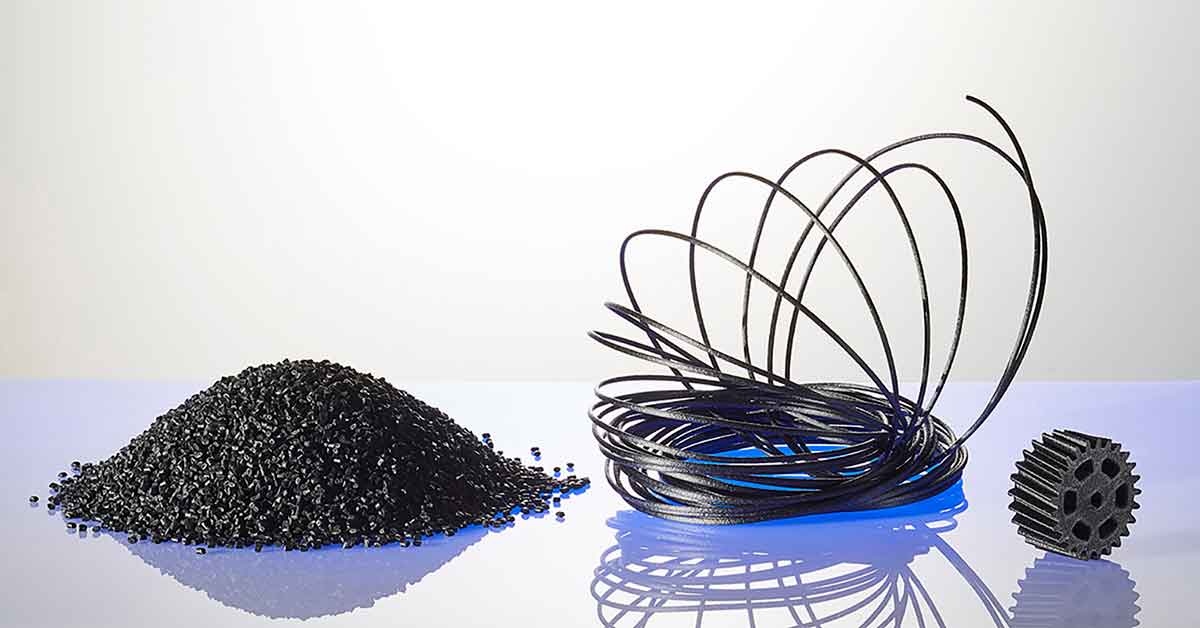
LATI3Dlab, a technological spin-off of LATI Industria Termoplastici, is dedicated to developing special thermoplastic compounds for filament 3D printing (FDM).
Among the latest innovations, electrically conductive materials have paved the way for new applications in medical, electronic, robotic sectors and advanced sensor technology.
Metal-like Conductivity with LATI3Dlab Compounds
Through the combination of carbon nanotubes and structured carbon black, LATI3Dlab researchers have succeeded in lowering the electrical resistivity of PLA-based plastic compounds to values below 10 Ω, very close to those of metals.
The result? Materials with uniform and isotropic conductivity, independent of the deposition method and infill degree.
This innovation is the result of a careful balance between electrical conductivity and filament flexibility, achieved through precise formulation and process studies.
Balance between Conductivity and Processability
An excessively conductive filament risks becoming brittle and unusable.
To prevent this, LATI3Dlab has introduced a PLA matrix which, combined with a selected elastomer and conductive fillers, ensures flexibility and mechanical integrity during winding and spool use.
The success is also due to optimal extrusion technique and a likely phase segregation that concentrates conductive charges in one of the two polymer phases, further increasing the conductivity of the printed material.
From Laboratory to Real Applications
This technology has given rise to Alfaohm filament, distributed by Filoalfa, used by Dr. Jesús E. Contreras-Naranjo‘s team at the Instituto Tecnológico y de Estudios Superiores de Monterrey to 3D print a conductive sensor for portable medical applications.
After surface preparation and activation, the sensor demonstrated the ability to transmit electrical signals from an electroanalytical device for the detection of specific chemical substances.
Project details are published in Electrochemistry Communications, 130 (2021) 107098.
Towards New High-Tech Applications
LATI3Dlab conductive compounds combine high performance and rapid production typical of FDM printing, enabling the creation of customized, low-cost, and disposable components.
Thanks to these characteristics, the new LATI3Dlab materials represent an ideal platform for developing supercapacitors, lithium-ion batteries, solar cells, and next-generation wearable devices.
 Accessibility Statement