

The Evolution of Materials for Functional 3d Printing
In recent years, FFF (Fused Filament Fabrication) 3D printing has moved beyond the experimental phase, becoming a real production technology even for structural and industrial components.
This transformation is due to the introduction of reinforced technical filaments for 3D printing, designed to provide printed parts with mechanical strength, dimensional stability, and advanced functional properties.
Among the leaders of this evolution is LATI3Dlab, a specialized division of LATI Industria Termoplastici, which brings over seventy years of experience in technical compounds to the world of additive manufacturing.
Today, LATI3Dlab offers a range of about 30 AM compounds, including formulations:
- reinforced with glass or carbon fiber,
- flame retardant,
- self-lubricating or metal detector detectable,
- electrically and thermally conductive,
- radiation shielding or with dissipative properties.
The base materials include not only PLA, ABS, and PETg, but also modified PA, PP, PPS, and PEEK, to cover a wide range of technical needs.
LATAMID 12 AM H2 K/05: High-Performance Reinforced Filament
An emblematic example of reinforced technical filament for 3D printing is LATAMID 12 AM H2 K/05, developed by LATI3Dlab and adopted by the Polish company Finnotech Sp. z o.o., specializing in technical filaments for additive manufacturing.
This material is based on a heat-stabilized polyamide, designed to:
- limit moisture absorption,
- maintain consistent filament workability,
- ensure excellent layer adhesion and dimensional stability,
- resist mechanical fatigue and creep deformation.
The long carbon fiber reinforcement, carefully engineered, provides stiffness and resilience without compromising structural flexibility, an essential aspect in functional parts subjected to dynamic loads.
Real Application: Motor Mounts for Electric Skateboard
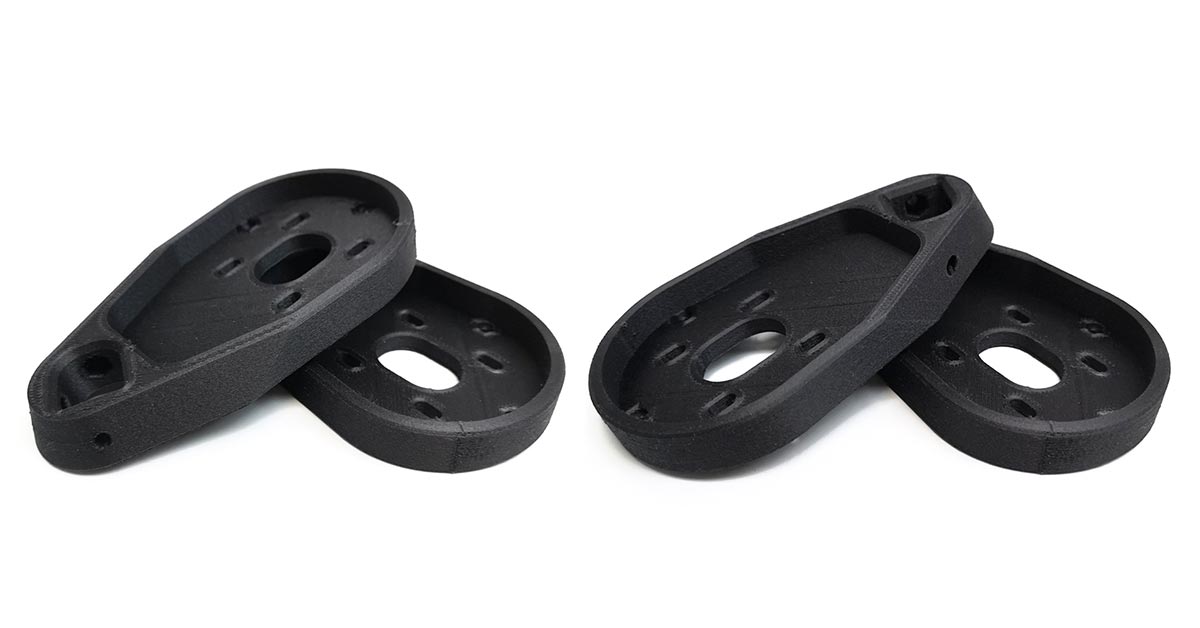
The effectiveness of LATAMID 12 AM H2 K/05 was demonstrated by Finnotech Sp. z o.o., which used it to produce motor mounts in FFF 3D printing for a new model of electric skateboard.
The design requirements were particularly challenging:
- high mechanical strength,
- uniform stress distribution along the structure,
- ability to absorb vibrations and reduce stress concentrations.
In the case of overly rigid materials, the motor mounting constraints to the metal frame could have experienced localized failures.
The reinforced LATAMID 12 AM H2 K/05 compound, thanks to its combination of toughness and stiffness, ensured controlled stress distribution, maintaining dimensional stability and resistance over time.
The optimization of infill and print layer orientation also allowed for:
- absence of visible deformations,
- no creep failure,
- functional stability even under prolonged loads.
Advantages of Reinforced Technical Filaments
The use of technical compounds for 3D printing allows overcoming the limitations of standard materials like PLA or ABS, extending 3D printing to functional and structural components.
| Properties | Reinforced technical filament | Standard filament |
| Elastic modulus | Up to 3–4 GPa | 1–2 GPa |
| Thermal resistance | >120°C | 50–70°C |
| Mechanical strength | High (long fiber) | Medium |
| Moisture absorption | Low | High |
| Dimensional stability | Excellent | Limited |
| Applications | Mechanical, industrial, structural | Aesthetic prototypes |
Thanks to these performances, reinforced filaments are ideal for the production of technical parts, structural supports, mechanical components, housings, gears, and electrical enclosures.
Advanced Materials for Additive Manufacturing
LATI3Dlab continues to develop innovative AM compounds, including:
- reinforced polyamides for functional uses,
- PPS and PEEK for high-temperature environments,
- conductive materials for ESD and ATEX applications,
- sustainable and biobased polymers to reduce environmental impact.
These technical filaments for 3D printing allow combining lightness, precision, and robustness, opening new opportunities for industrial design and functional prototyping.
Conclusion
Do you want to improve the performance of your 3D printed components?
Discover LATI’s range of reinforced technical filaments for 3D printing, designed for structural and industrial applications.
Learn more at www.lati.com.
FAQ – Reinforced Technical Filament for 3d Printing
- When is it advisable to use a reinforced technical filament?
When high mechanical strength, thermal stability, and dimensional precision are required, such as in functional or mechanical parts. - What reinforcements improve filament performance?
Glass fibers increase stiffness and strength, while carbon fibers improve lightness, conductivity, and stability. - Are reinforced filaments compatible with standard FFF printers?
Yes, but a hardened nozzle and an appropriate extrusion temperature (>260°C) are recommended to handle fibrous reinforcements.
 Accessibility Statement