

Advanced Materials for Workplace Safety
In the field of personal protective equipment (PPE), safety and comfort are two fundamental requirements.
When ergonomics or functionality are compromised, operators tend not to wear their devices correctly, jeopardizing protection and effectiveness in the workplace.
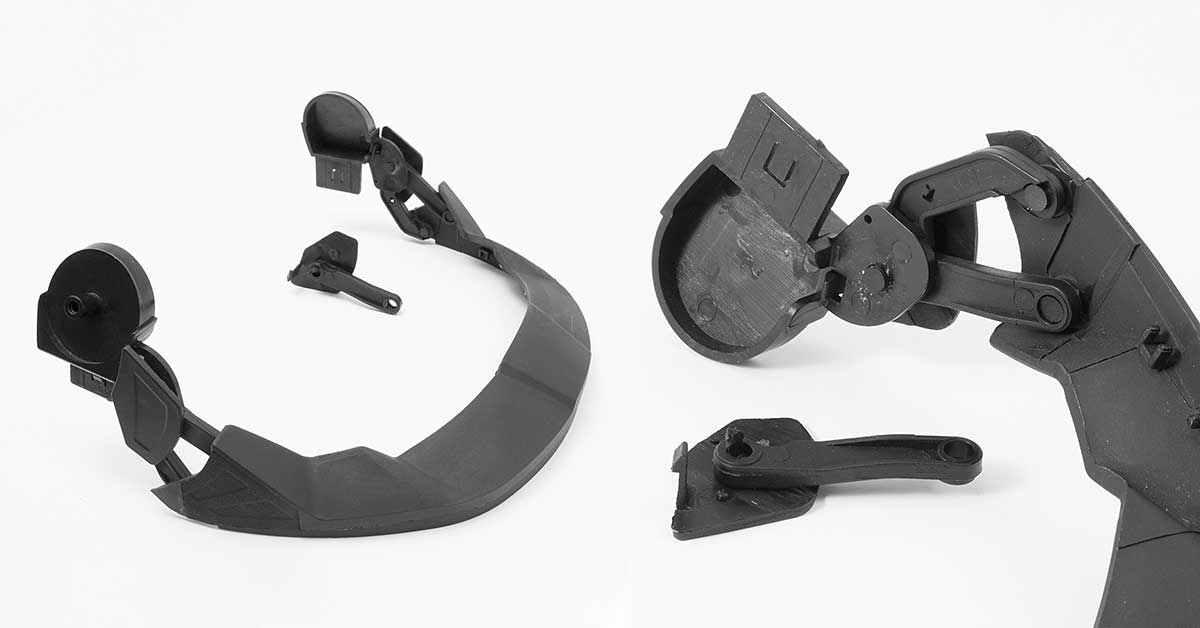
To ensure consistent and comfortable use, the German company ENHA GmbH, specializing in the production of protection systems for head, face, hearing, and respiratory tracts, has chosen to adopt LATILUB self-lubricating compounds from LATI Industria Termoplastici S.p.A. in the adjustment and lifting mechanisms of their protective visors.
LATILUB: Self-Lubricating Compound for Smooth and Long-Lasting Movements
The opening and closing system of ENHA protective helmet visors is made entirely of self-lubricating technopolymer, capable of combining lightness, reliability, and smooth sliding.
The material selected for the actuating lever is LATILUB 66-10T Y/15, a compound based on PA66 (polyamide 66) formulated with PTFE and aramid fibers.
Main properties:
- Reduction of the friction coefficient thanks to PTFE (polytetrafluoroethylene).
- Smooth and jam-free operation even with minimal effort.
- Resistance to adhesive and abrasive wear for continuous use.
- Dimensional stability and mechanical robustness of the assembly.
- Long-term reliability even in the presence of dust or impurities.
The aramid fibers dispersed in the polymer matrix limit wear from direct contact and that caused by third-party particles, extending the useful life of the component even in harsh environments.
A System without External Lubricants
For some parts of the lifting system, ENHA has used a second material, LATILUB 66-01M, also based on PA66, but additivated with molybdenum disulfide (MoS₂).
This combination allows for further reduction of wear at friction points and completely eliminates the need for lubricating greases or oils.
The adoption of self-lubricating compounds offers concrete advantages for PPE:
| Advantage | Practical effect |
| No external lubricant | Reduced maintenance and contamination risk |
| Reduced friction | Smooth and silent movements |
| Long-term stability | Consistent performance even with intensive use |
| System cleanliness | No accumulation of dirt or dust |
| Long operational life | Less wear and greater reliability |
These characteristics translate into ergonomics, safety, and durability, key elements for personal protection.
Self-lubricating Compound for PPE Applications
LATI offers the LATILUB line for applications requiring dry lubrication, i.e., without external oils or greases, ensuring consistent operation over time.
Self-lubricating compounds are used in numerous safety components and movement mechanisms, such as:
- Visors and adjustment systems for protective helmets.
- Hinges, bushings, slides, and technical gears.
- Locking or adjustment devices subject to repeated wear.
Thanks to the combination of PTFE, graphite, or molybdenum disulfide, LATILUB offers excellent tribological performance combined with the thermal and chemical resistance of technical polyamides.
A Combination of Ergonomics and Safety
The use of LATILUB self-lubricating compounds in ENHA PPE demonstrates how material design can actively contribute to operator safety and comfort.
The ability to integrate mechanical functions, lubrication, and dimensional stability into a single material reduces the risk of failures and ensures effective protection over time.
Contact Us
Discover the LATILUB range of LATI self-lubricating compounds for safety components and personal protective equipment.
Contact the technical team for advice on choosing the most suitable material for your application needs.
FAQ – Self-lubricating Compound for PPE
- Why use self-lubricating compounds in PPE?
To achieve smooth and reliable movements without maintenance, improving comfort and durability of safety devices. - What are the main lubricating additives in technical compounds?
PTFE, graphite, and molybdenum disulfide, which reduce friction and wear even in harsh conditions. - In which PPE components are they used?
In levers, hinges, bushings, lifting or sliding systems, where smooth and consistent movement is needed.
 Accessibility Statement