

Innovation in Thermal Dissipation Systems for Lighting
In modern lighting technology, heat management represents one of the main design challenges.
High-power LEDs, while ensuring energy efficiency and long life, generate a significant amount of concentrated heat, which must be effectively dissipated to prevent performance degradation or damage to electronic components.
In this context, thermally conductive thermoplastic compounds are rapidly replacing traditional metal heat sinks, offering lightweight properties, design freedom, and reduced production costs.
The Whitecroft Lighting Project: Conductive Technopolymer Heat Sinks
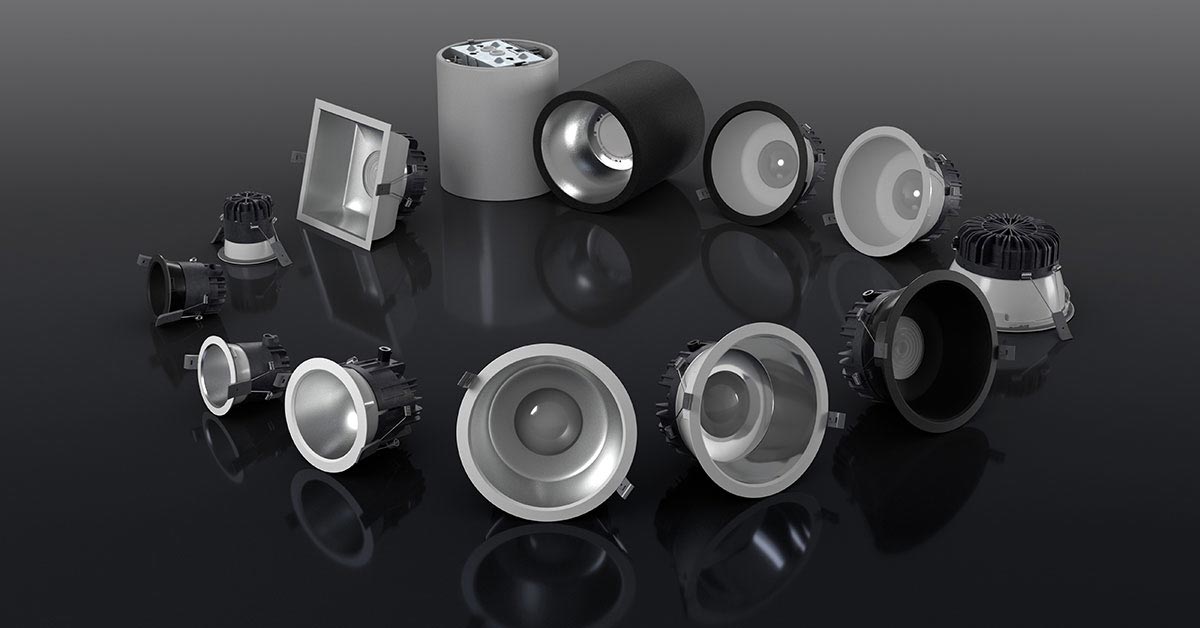
British-based Whitecroft Lighting, specializing in lighting solutions for public and private spaces, has adopted LATI’s thermally conductive compounds to produce heat sinks for the Mirage 3 lamp series.
The project was developed in collaboration with:
- Protool Plastics Group, specialist in injection molding of technical materials,
- and LATI Industria Termoplastici, with over twenty years of experience in developing thermally conductive compounds for industrial applications.
LATICONTHER 62 GR/50: Performance and Reliability
For the heat sinks, LATICONTHER 62 GR/50 compound was selected, a PA6 filled with 50% graphite by weight, capable of ensuring thermal conductivity above 10 W/mK.
Main Properties of LATICONTHER 62 GR/50 Compound
|
Property |
Typical value |
Technical benefit |
|
Polymer matrix |
Polyamide 6 (PA6) |
Excellent stability and processability |
|
Conductive filler |
50% graphite by weight |
High thermal conductivity |
|
Thermal conductivity |
> 10 W/mK |
Efficient heat dissipation |
|
Density |
1.8 g/cm³ |
Lighter than aluminum |
|
Production process |
Injection molding |
High productivity and dimensional accuracy |
This material, already established in the lighting sector, offers an excellent balance between thermal conductivity, rigidity, and dimensional stability, making it ideal for compact and high-performance heat sinks.
Design Simulation and Optimization
The project’s success was possible thanks to an integrated approach between design and simulation.
LATI performed numerical simulation of the molding process and thermal performance, optimizing the heat sink geometry to maximize heat exchange and reduce deformation during production.
In parallel, Protool Plastics Group managed the mold setup and process parameters, ensuring quality consistency and reliability of the final component.
The result is an efficient and industrializable dissipation system, suitable for LED lamps over 4000 lumens, combining metal-level thermal performance with the advantages of engineering plastics.
Advantages of Thermally Conductive Thermoplastic Compounds
The use of thermally conductive thermoplastic compounds as an alternative to metals offers numerous design and production advantages:
|
Advantage |
Description |
|
Weight reduction |
Up to 50% compared to aluminum |
|
Design freedom |
Complex geometries and functional integration |
|
Cost-effectiveness |
Elimination of post-molding mechanical operations |
|
Electrical insulation |
Safety and compatibility with LED circuits |
|
Sustainability |
Recyclability and lower environmental impact |
These materials allow combining thermal performance with design flexibility, simplifying the production of advanced lighting devices.
Results and Applications
The Mirage 3 series was successfully launched in 2020 in three different sizes, all based on LATICONTHER polymeric heat sinks.
Results confirmed the thermal and mechanical stability of the system, with controlled operating temperatures even in compact LED configurations.
This technology has proven particularly suitable for:
- LED fixtures for architectural or industrial use,
- ceiling lights and projectors for hospitals and schools,
- outdoor lighting and smart lighting systems.
Conclusion
Discover LATI’s range of thermally conductive thermoplastic compounds, developed for heat sinks, electronic components, and industrial cooling solutions.
Learn more about technical data and applications at www.lati.com.
FAQ – Thermally Conductive Thermoplastic Compound
- What distinguishes a conductive thermoplastic compound from a metallic material?
It offers similar thermal dissipation capacity but with lower density, reduced costs, and greater design freedom. - Which fillers improve conductivity in thermoplastics?
Graphite, carbon fibers, boron nitride, and alumina are among the most common fillers. - In which applications are these compounds used?
LED heat sinks, electronic components, battery housings, and heat-exposed structural parts.
 Accessibility Statement