

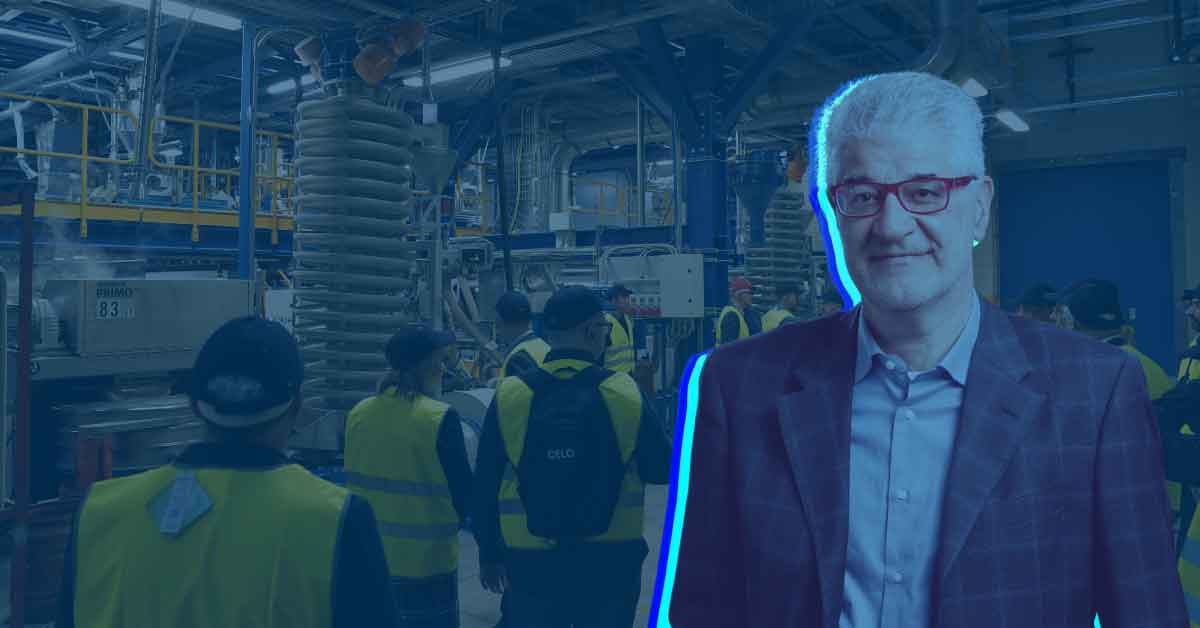
In this article, we report the full text of the interview with Andrea Lugli, Group Manufacturing Director of LATI, conducted by the weekly Operations Manager of Post Media SRL. An in-depth look at LATI’s strategies for integrating certifications into its business processes through training, KPIs, and internal audits.
For the operations director of the Varese-based technical thermoplastics company, these are the three keys to best integrating the requirements of a new certification into the company’s processes. “The controls? They may appear to be an additional difficulty to manage, but in reality, they don’t slow down the flows: frequent audits allow us to have a constant view of operations and to intervene promptly to improve them”
It’s true: for a company, deciding to obtain a certification requires significant commitment from various perspectives. Yet, this goal can become a driver for improving its processes, transforming into an engine of efficiency, quality, sustainability, and, not least, standardization. Andrea Lugli, operations director of LATI Industria Termoplastici, active in the production of technical thermoplastics for engineering use in various sectors – from automotive to medical, from food production and processing to household appliances and many others – also thinks this way. In his role, Lugli manages the production and maintenance areas of the company’s two plants in Vedano Olona (VA). Among acronyms, numbers, and audits, in this interview, LATI’s operations director explains how certifications impact his activity, the benefits that can be derived, and the complexities that need to be addressed.
Lugli, let’s start right there. What are the main certifications that LATI has obtained and what implications do they have in operations management?
First of all, there’s ISO 9001 for the quality management system, which for our sector can almost be considered a basic requirement to be in the market. We’ve also added IATF 16949, necessary for working in the automotive sector. The latter is particularly challenging, as it requires us to ensure a very high level of service to our customers: for example, we must inform them of every industrial intervention we make, such as a plant change, and guarantee that all this is carried out according to specific and documentable procedures. Furthermore, LATI was among the first Italian small-medium enterprises to be certified ISO 14001 for environmental management and, related to this, I also mention ISO 50001, which refers to the energy management system and which we obtained at the beginning of this year. For a few years now, we’ve also had ISO 45001 for safety, another topic close to the company’s heart: we organize dedicated training courses for specific roles and, thanks to collaboration with the HSE department, we strive to design procedures that allow us to avoid problems in this area. Without naming all the product certifications related to the various sectors our products are intended for, I’ll conclude by saying that a few days ago we obtained Operation Clean Sweep which, for a company like ours that produces granulates, refers to the cleanliness of work environments.
One might say you’re constantly under audit…
Yes, indeed it’s not an exaggeration. For example, IATF not only sees us as ‘special subjects’ of our customers, but also requires us to ‘audit’ our suppliers in turn. Although controls may appear to be an additional difficulty to manage, in reality, they don’t slow down production flows: frequent audits, if managed correctly, allow us to have a constant view of processes and to intervene promptly to improve them. Rather than a burden, therefore, they are an opportunity. Certainly, they also represent a challenge, but they also give us the possibility to standardize our processes: working on the repeatability of what we do allows us to find systematic and, therefore, efficient operating methods. Allow me to draw a parallel with school: when a teacher constantly tests, one is motivated to always be prepared and doesn’t tackle everything at the last moment.
How do you then ensure that adapting to the various certification requirements doesn’t slow down innovation, especially in processes?
At LATI, we have a Technical Office dedicated to technological innovation and product industrialization: we collaborate closely with them (and with the IT department) to ensure that every plant or digital innovation is compatible with the quality, environmental, and efficiency standards required by certifications. This is why our engineering studies can take quite a long time: we consider it important that innovations are designed to be tailored to our company, ‘tailor-made’ for our processes. For example, we recently implemented IoT (Internet of Things) on all our plants with a control system that integrates MES (Manufacturing Execution System) and our SAP management system. This allows us to monitor in real-time data ranging from logistics to production and to record all useful information to improve processes. In this way, innovation not only doesn’t slow down but integrates perfectly with the standardization needs required by certifications.
When you decide to obtain a new certification, what helps you to best integrate it into your processes?
There are at least three keys. First of all, upstream preparation of both managerial and operational figures is fundamental, through training phases that can be prolonged. Then we need to measure ourselves through very detailed KPIs, without which it would not be possible to improve: often, in fact, those who audit us provide rather generic quality standards that don’t take into account the specificities of our company. It’s a bit like a diet: if you don’t weigh yourself regularly, you don’t know if and what progress you’re making. Finally, the third key is internal controls, from which areas for improvement always emerge.
Can it happen that the requirements of different certifications overlap, perhaps creating inefficiencies or weighing down processes?
In reality, we can say it’s the opposite: overlaps can work in our favor and, indeed, we try as much as possible to find synergies between different certifications. The most typical case is, for example, that of ISO 9001 and ISO 14001 certifications, which can be easily integrated as they both follow a common structure (the High-Level Structure) and therefore use the same basic principles. Moreover, it can happen that working to obtain a certification in one area also helps in another context: for example, identifying well-defined, systematic, and standardized operating methods also favors the adoption of safer practices and processes, reducing the margins of error for individuals. Sometimes we also conduct combined audits, thus optimizing time and resources
What complexities do you encounter in translating certification requirements and standards into processes?
The greatest complexity is given by the management of the so-called ‘change management’ of people, perhaps accustomed for many years to performing certain tasks in certain ways that certifications ask to modify. This process must be accompanied by adequate employee training and, not infrequently, also by a demonstration of the fact that the new operating methods help them work better, more safely, and in leaner times. This change takes time, especially when introducing new digital technologies or new plants. At LATI, for a couple of years now, we have also launched a Lean Manufacturing project across all company areas precisely to favor this evolution: we asked those who experience the factory every day, therefore the operational staff and shift leaders, what their way of working was and in this way we managed to make it more efficient and create standards. The latter have favored safety, made us more efficient, and reduced our waste in terms of resources and costs. In parallel, the Lean Manufacturing project has favored a change in people’s mentality and at the same time motivated them to get back into the game to be more effective in carrying out their duties.
 Accessibility Statement