

Light conduction in thermoplastic materials represents one of the most advanced technologies for designing aesthetic and functional components in the electronics, lighting, and automation sectors.
The LASTILUX line, developed by LATI, introduces transparent and diffusive compounds capable of guiding, modulating, or emitting light, while ensuring mechanical, thermal, and aesthetic stability.
What is a Transparent Compound for Light Conduction
A transparent compound for light conduction is a thermoplastic material formulated to transmit or diffuse light in a controlled manner, utilizing refraction, reflection, or fluorescence phenomena.
These materials are used for:
- Lighting components (LED diffusers, light guides, light indicators)
- Aesthetic and functional applications in industrial design
- Sensors and optical devices in the electronics and medical fields
Thanks to their calibrated optical properties, they allow for homogeneous and customized light effects without the use of additional optical elements.
The Two Families of LASTILUX Compounds
The LASTILUX range includes two main types of transparent compounds, developed for different optical functions.
LASTILUX OPALI: Uniform Light Diffusion
The LASTILUX OPALI compounds are designed to diffuse light evenly, creating a controlled opalescent effect.
They are particularly suitable for applications where it is necessary to hide the point light source (such as LEDs) while ensuring uniform and continuous brightness.
Examples of use:
- linear LED covers
- decorative light panels
- components for vehicle interiors and electronic equipment
LASTILUX COLORED: Controlled Conduction and Fluorescence
The LASTILUX COLORED compounds (in green, yellow, red, etc.) absorb ultraviolet (UV) light and reemits it in the visible spectrum, generating a fluorescent effect.
When used in thin layers or targeted optical geometries, these materials allow for:
- concentrating light in specific areas;
- creating the impression that the object emits its own light;
- enhancing brightness under UV irradiation.
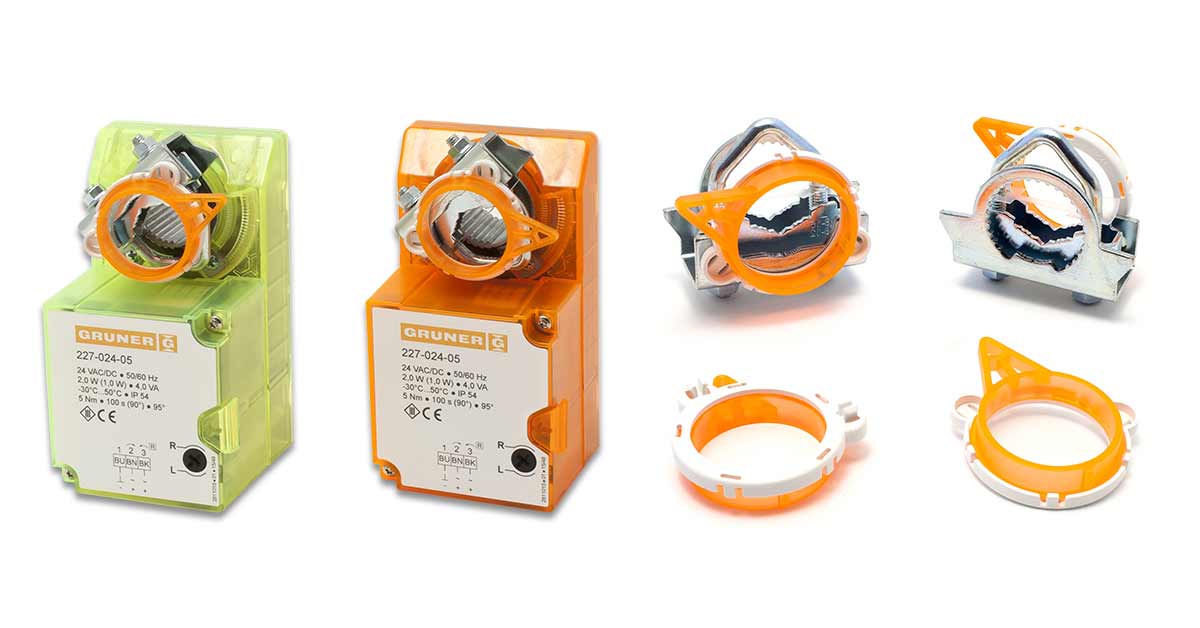
Application Case: Gruner AG and LASTILUX 87/28
The German company Gruner AG, specialized in relays and actuators, adopted the LASTILUX 87/28 compound to create a light slider and the corresponding housing for an actuator intended for ventilation and air conditioning systems.
The design requirements included:
- high aesthetic quality of the surface;
- optimal light transmission through the geometry of the piece;
- dimensional stability;
- color uniformity and long-term resistance.
The choice of a transparent polycarbonate (PC) based compound ensured excellent optical performance, mechanical robustness, and thermal reliability, making the material ideal for visible aesthetic components.
Technical Properties of LASTILUX Compounds
| Properties | LASTILUX OPALI | LASTILUX COLORED |
| Optical effect | Homogeneous diffusion | Controlled fluorescence |
| Polymer base | PC (polycarbonate) | PC (polycarbonate) |
| Light transmission | High | High |
| Operating temperature | -40 °C / +120 °C | -40 °C / +120 °C |
| Alteration of mechanical properties | Negligible | Negligible |
| Workability | Injection molding | Injection molding |
LASTILUX formulations do not alter the electrical or mechanical properties of the base resin, maintaining ease of molding and consistent optical reproducibility.
Technical Advantages of LASTILUX Transparent Compounds
- Controlled light management (diffusion or direct conduction)
- Compatibility with LED and UV sources
- Uniform aesthetics without surface defects
- Excellent dimensional and color stability
- Standard industrial processability (without secondary additives)
These characteristics make the compounds ideal for integrated lighting projects, signage, functional design, and high-precision visual components.
FAQ – Frequently Asked Questions about Transparent Compounds for Light Conduction
- What is the difference between a transparent material and a light-conducting one?
A transparent material allows light to pass through, while a light-conducting compound is designed to guide and distribute it in a controlled manner within the component. - Are LASTILUX compounds suitable for injection molding?
Yes, they can be processed with standard thermoplastic molding techniques without altering optical performance. - Is it possible to customize the color or light diffusion?
Yes, LASTILUX formulations allow for modulating the level of opalescence or fluorescence according to the aesthetic and functional needs of the project.
Conclusion and call to action
Transparent compounds for light conduction represent an advanced solution for designing optical and functional components.
Thanks to the LASTILUX range, it is possible to achieve precise, stable, and reproducible light effects, while maintaining high mechanical and production standards.
Do you want to explore LASTILUX solutions for your lighting or functional design project?
Request a customized technical evaluation to identify the most suitable compound for your application.
 Accessibility Statement