

In the world of industrial handling and controlled friction mechanical systems, the choice of bushing material is crucial to ensure durability, smoothness, and reliability over time.
Today, self-lubricating compounds represent one of the most efficient solutions, eliminating the need for external lubricants and minimizing the wear of associated metal components.
Self-lubricating Bushings for Forklifts: the GGB Case
A major forklift manufacturer has designed an innovative steering system, where the steering column can rotate 30°, facilitating operator access to the cabin.
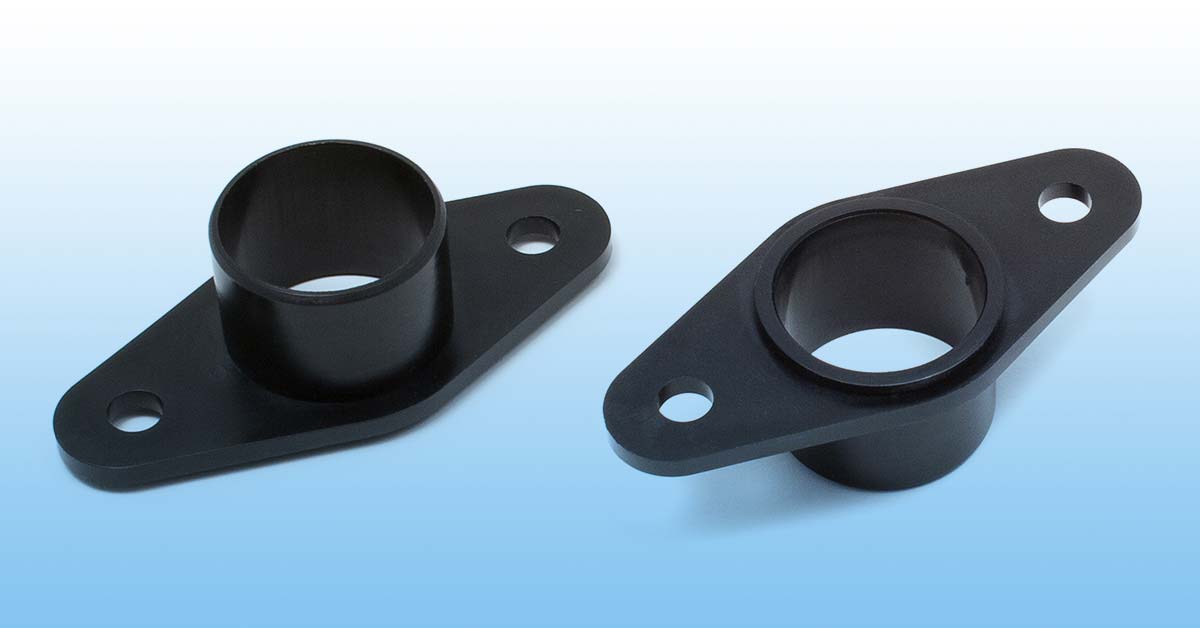
The movement is made possible by two self-lubricating bushings developed by GGB using the LATILUB EP®22 compound, based on PBT and loaded with PTFE.
Technical Data of the Sliding System
| Parameter | Value |
| Inner diameter of bushing | 25 mm |
| Outer diameter | 28–30 mm |
| Length | 22.5 mm |
| Flange width | 35 mm |
| Overall system length | 75 mm |
| Applied load | 600–700 N |
| Usage frequency | 5–30 operations/day |
| Sliding speed | ≤ 1 m/s |
The self-lubricating bushings center a 145 mm long oscillating metal rod, ensuring smooth and precise movements even under intensive use conditions.
The LATILUB EP®22 Compound: PBT + PTFE Technology
The EP®22 self-lubricating compound is distinguished by its ability to operate dry or with lubricant, maintaining a low friction coefficient and excellent corrosion resistance over time.
Main Technical Properties
| Property | Typical value |
| Polymer base | PBT (polybutylene terephthalate) |
| Internal lubricant | PTFE |
| Friction coefficient | 0.22 – 0.37 |
| Operating temperature | -50 °C / +170 °C |
| Max sliding speed | 1 m/s |
| Compliance | ELV, WEEE, RoHS |
| Workability | Turning, milling, molding |
In addition to mechanical performance, the material features high vibration damping, reducing noise and vibrations during movement phases—a crucial advantage for applications in enclosed or high-frequency use environments.
Advantages over Traditional Reinforced Materials
Previously, bushings were made of glass fiber reinforced polymers, but this solution accelerated the wear of the oscillating metal column.
The EP®22 self-lubricating compound, free of glass fibers, eliminates the abrasion problem, ensuring:
- greater system longevity
- quiet operation
- maintenance-free
- reduced service costs
As confirmed by Andreas Epli, Automotive Project Engineer at GGB, “the material offers excellent damping and smoother, quieter movements, without the need for external lubricants.”
Ideal Applications for Self-Lubricating Compounds for Bushings
| Sector | Typical applications |
| Industrial handling | Forklifts, steering systems, oscillating supports |
| Automotive | Joints, steering supports, lightweight suspension systems |
| Automatic machinery | Guides, slides, rotating elements |
| Electromechanics | Actuators and precision devices |
FAQ – Frequently Asked Questions about Self-Lubricating Compounds for Bushings
- When is it useful to choose a self-lubricating compound?
When it is necessary to reduce friction and maintenance in systems with frequent sliding or oscillation, even without lubricants. - Are self-lubricating compounds compatible with corrosive environments?
Yes, thanks to the PBT base and absence of abrasive fibers, they resist well to moisture and chemicals. - Can they replace metal bushings?
In many cases, yes: they offer adequate mechanical resistance, reduced weight, and greater quietness.
Conclusion
The adoption of a self-lubricating compound for bushings like EP®22 allows for improved efficiency, operational comfort, and component durability, while reducing maintenance and environmental impact.
Do you want to evaluate the replacement of metal or reinforced bushings?
Request a custom technical evaluation to identify the most suitable self-lubricating compound for your application.
 Accessibility Statement