

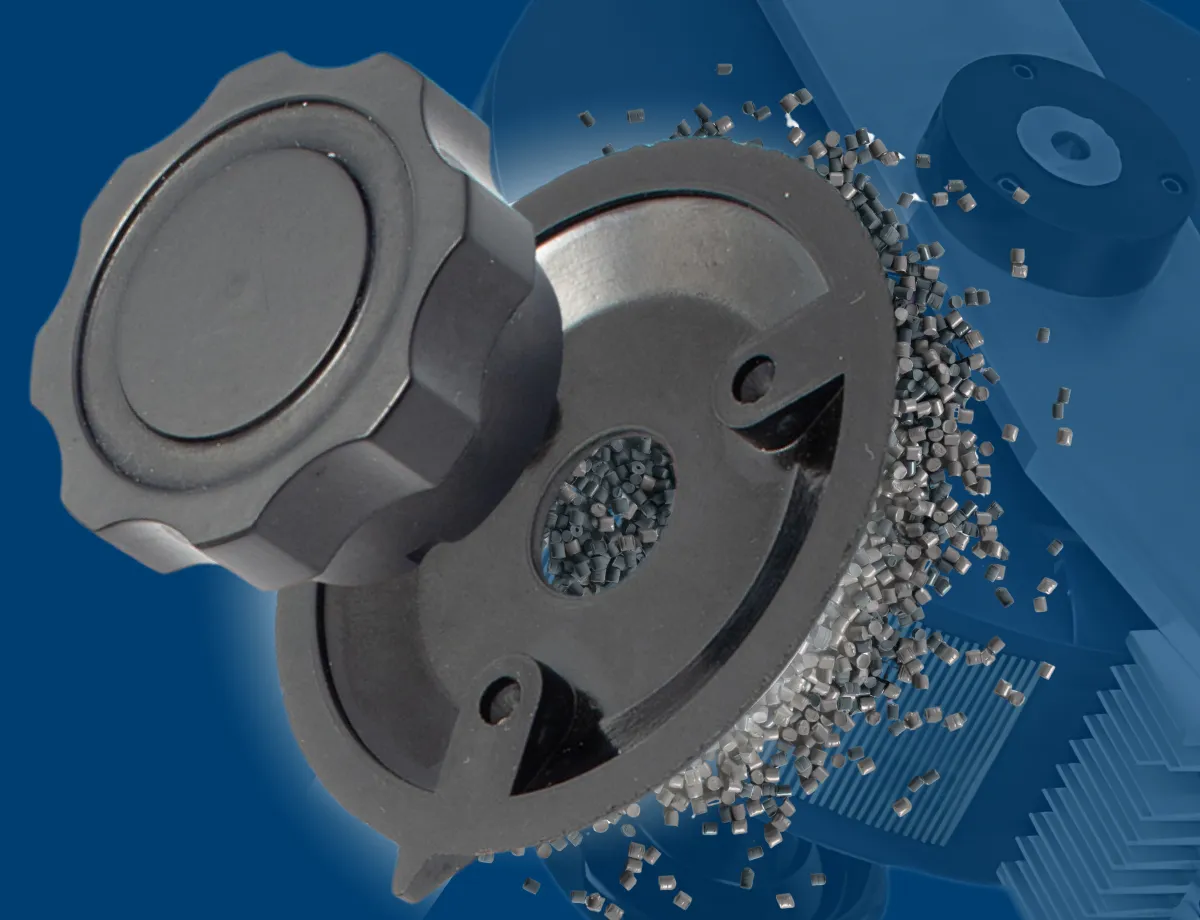
The replacement of traditional thermosetting materials, such as Bakelite, with thermoplastic engineering polymers represents one of the main evolutions in the design of insulating electrical components today.
In addition to ensuring equivalent performance in terms of safety and fire resistance, thermoplastic materials offer significant advantages in terms of processability, recyclability, safety, and production costs, making them an increasingly adopted solution in industrial electrical systems.
Electrical insulating components: application requirements
In voltage regulation systems, both single-phase and three-phase, insulating components must guarantee:
- high electrical safety
- thermal stability
- long-term reliability
- precision in control
Adjustment knobs and insulating bases play a fundamental role in the interaction between the operator and the system, contributing to improved ergonomics, protection, and operational continuity.
Self-extinguishing engineering polymers as an alternative to Bakelite in electrical insulating components
The injection molding company Talleres Sala, in collaboration with LATI, has proposed replacing Bakelite insulating parts with self-extinguishing engineering polymers for the TORIVAC application.
This transition represents a significant change from both a technical and production standpoint, introducing a solution that is:
- more sustainable
- recyclable
- economically competitive
Advantages of engineering polymers compared to Bakelite
The switch to thermoplastic materials allows for concrete benefits:
Sustainability and recyclability
Unlike thermosets, engineering polymers can be recycled, contributing to a reduction in environmental impact.
Production efficiency
Injection molding ensures:
- greater repeatability
- reduction of waste
- more efficient production cycles
Cost reduction
The improvement concerns both:
- the cost per single component
- mold maintenance
LATAMID 6 H2 G/30 V0HF1: performance and safety
Following a testing phase on adjustment knobs and insulating bases, LATAMID 6 H2 G/30 V0HF1 was selected, a polyamide 6 reinforced with 30% glass fiber and halogen-free self-extinguishing properties.
Key features include:
- UL94 V0 classification
- halogen-free
- high dimensional stability
- very high tracking resistance
These properties allow the material to meet the technical requirements of the application, ensuring safety and reliability.
Injection molding and component quality
A further determining factor in the choice of material is processability in injection molding.
LATAMID 6 H2 G/30 V0HF1 offers:
- stable rheological behavior
- homogeneous and uniform mold filling
- consistent surface quality
These aspects are fundamental for functional and visible components such as knobs and insulating bases.
[Discover the technical characteristics of LATAMID 6 H2 G/30 V0HF1]
Components for regulation systems: safety and usability
Voltage regulation accessories are designed to facilitate integration into electrical systems and improve the user experience.
The use of advanced engineering polymers allows for the optimization of:
- component ergonomics
- operator safety
- overall system efficiency
Self-extinguishing engineering polymers for electrical applications
The use of halogen-free self-extinguishing materials is now a standard for many electrical applications.
These materials allow for:
- the creation of applications that are reliable over time and safe in the event of fire
- compliance with increasingly stringent safety regulations regarding environmental and human health protection
- improved product sustainability
FAQ – Bakelite replacement and insulating materials
Why replace Bakelite with engineering polymers?
To improve sustainability, recyclability, and processability while maintaining high technical performance.
Are engineering polymers suitable for electrical applications?
Yes, they offer electrical insulation, thermal resistance, and self-extinguishing properties.
What advantages does injection molding offer?
Greater production efficiency, cost reduction, and consistent component quality.
What does halogen-free material mean?
A material free of halogens, which is safer in the event of fire and compliant with environmental regulations.
Can engineering polymers completely replace thermosets?
In many applications, yes, especially when high performance and sustainability are required.
 Accessibility Statement