

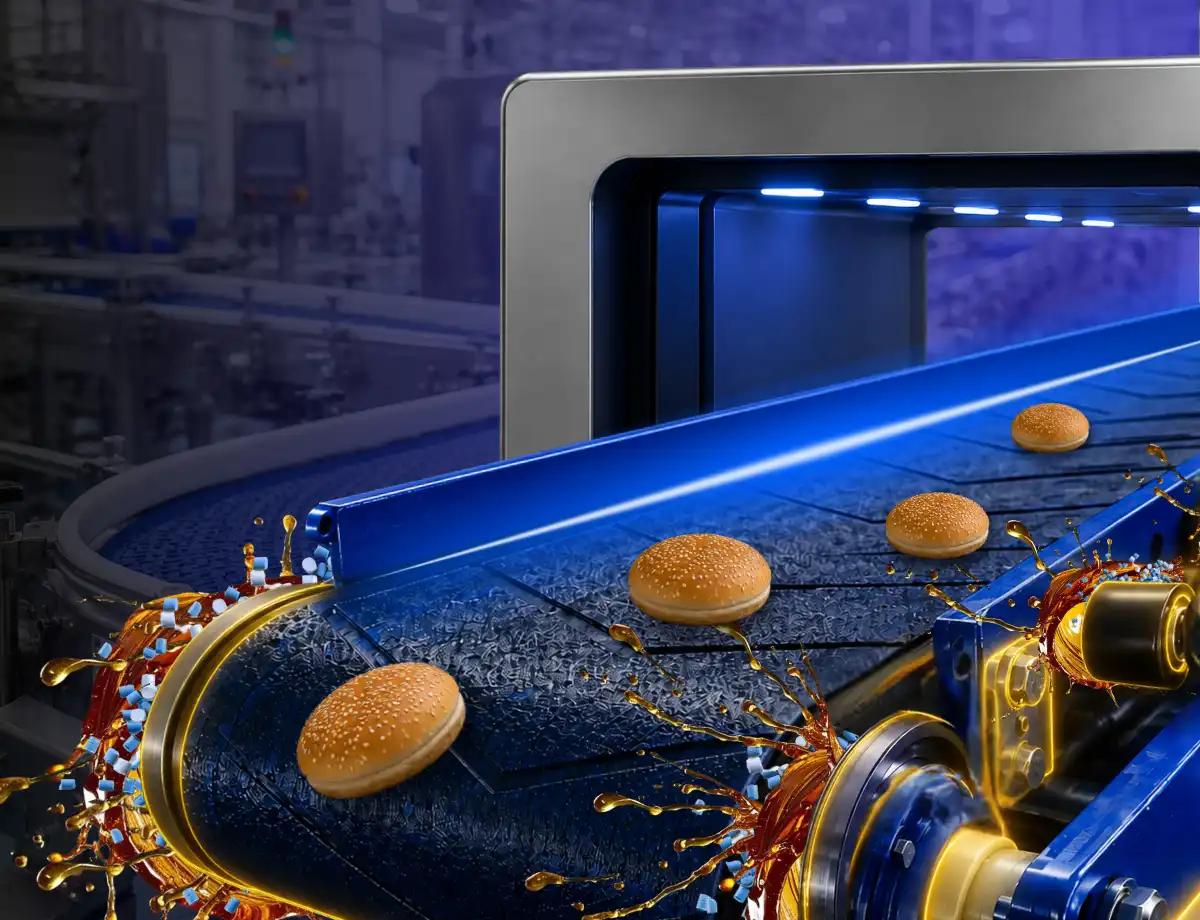
Those who design conveyor belts, guides, roller conveyors, and accessories for the food sector today must not solve just a single problem, but address a combination of constraints. Components must be mechanically reliable, operate with low friction, resist washing and sanitizing agents, limit dirt accumulation, and, in many cases, also be detectable by the control systems present on the line.
This guide integrates what has already been explored in the content dedicated to how to choose detectable materials for food conveyor belts or how to reduce the risk of plastic contamination in food processing. This content is designed for an OEM or a technical office: to build a material selection checklist that helps bring together detectability, tribological requirements, antistatic properties, dimensional stability, and the working environment.
The selection checklist: where to really start
Before choosing the material, it is advisable to focus on some key questions.
- Is the component close to the food product or in a critical area for contamination?
- Is there relative motion between the elements that allow transport? If so, against which counterpart: metal, polymer, or elastomer?
- What is the main problem? Friction, wear, noise, dirt accumulation, aggressive sanitization and washing, or the formation of electrostatic charges?
- In the event of breakage and fragment dispersion, is detectability required for metal detectors, X-rays, or both?
- Is dimensional precision or impact resistance more important?
- Does the component work in a dry, humid, or dusty environment subject to frequent cleaning?
Only after this analysis does it make sense to decide whether to opt for a self-lubricating, magnetically detectable, or electrically conductive solution, or a combination of requirements within the LATI thermoplastic materials range.
1. Detectability: when it is truly a design requirement
In food processing, detectability is not an option. If a plastic part breaks accidentally, the fragment must be reliably intercepted regardless of its geometry. But the correct question is not just “is the material detectable?”, but also “will the pollutant, in its real form and on my line, be detectable in a manner consistent with the available inspection system?”.
To further explore the comparison between safety technologies, it is best to refer to the guide on metal detector and X-ray detectable materials. Here, the key point is different: detectability must be framed alongside other factors such as part size, thickness, orientation, the point on the line where the component operates, and the level of acceptable risk.
For some components, detectability is a priority: modules, guides near the product, lifting buckets, accessories, ties, tools, and parts subject to wear or impact. In these cases, it makes sense to consult the guide dedicated to detectable plastic components for ties and accessories.
2. Friction and wear: the heart of conveyor performance
Many conveyor systems fail not due to a lack of general mechanical strength, but because of poorly managed friction. Friction that is too high means greater power absorption, more localized heat, more noise, irregular wear, and more maintenance, as well as the formation of particulates. For this reason, on sliding modules, guides, pads, rollers, wheels, and bushings, the issue is not just “resisting,” but “resisting while sliding well.”
Here, LATILUB self-lubricating materials become central, designed to reduce friction, wear, and noise without resorting to external greases or oils. For those who want to delve deeper into the technical details, the reference is the guide on self-lubricating materials for conveyor belts, guides, and roller conveyors.
From a design perspective, the important point is this: a detectable material with inadequate tribological performance can increase the risk of system wear. For this reason, in more advanced food conveyors, detectability and low friction must be evaluated simultaneously.
3. Antistatic properties and conductivity: when they are truly needed
In many food lines, plastic in relative motion tends to become electrostatically charged. The result can be product adhesion to surfaces, the accumulation of dust or dirt, and in some cases, broader process problems. This is particularly evident when handling dry, light, or dusty products.
When electrostatic charge becomes a critical issue, it is useful to evaluate electrically conductive thermoplastic materials and specific antistatic compounds. In some scenarios, the best solution is not to choose between detectability and antistatic properties, but to set up the project so that the component meets both needs.
For those operating on food conveyors, this is an important distinction: a system that controls contamination and friction well but accumulates charges can continue to create product adhesion problems, dirt accumulation, and operational irregularities, up to real safety issues related to high-voltage discharges.
4. Washing, sanitizing agents, and operating environment
Many material selection errors arise from the fact that the component is evaluated only on its mechanical cycle, ignoring the actual working context. In the food sector, however, the material must coexist with water, humidity, detergents, sanitizing agents, dust, and thermal shocks.
For this reason, selection criteria should not be sought in the material’s technical data sheet, but through verification under real line conditions: washing frequency, type of detergent, temperature, belt speed, load, environmental contamination, and the actual counterpart.
The guide on detectable materials for food conveyor belts remains the reference for the specific focus on detectability in food conveyors.
5. There is no single material for the entire conveyor system
A conveyor system is not a single component. Soft belts, rigid modules, guides, accessories, bushings, rollers, and supports work under different conditions and require different solutions.
- In soft belts and flexible components, elasticity, surface continuity, and processability are what matter.
- In rigid modules and guides, dimensional stability, rigidity, low coefficient of friction, and wear resistance become crucial.
- In rollers and bushings, moving mass, noise, fatigue resistance, and coupling precision carry significant weight.
- In accessories and minor components, especially in the food area, the priority may shift to detectability and the possibility of visual inspection.
For this reason, the correct choice is not “which material to use for the conveyor?”, but “which material to use for this specific component, at this specific point in the system, and with these overall requirements?”.
6. The minimum decision matrix for OEMs and technical offices
| Dominant requirement | Guiding question | Families/approaches to evaluate |
| Detectability | Is the component in a critical area for contamination? | MDT and food-conveyor grades |
| Low friction | Is there continuous or stop-and-go relative motion? | LATILUB / self-lubricating formulations |
| Antistatic Properties | Does the product adhere or does dirt accumulate? | LATISTAT / conductive compounds |
| Sanitization | Does the part undergo frequent or aggressive washing? | Matrices with adequate chemical resistance |
| Precision | Does misalignment generate noise or irregular wear? | Polymers and fillers for dimensional stability |
Conclusion
For food conveyor systems, the correct material rarely coincides with the solution that excels in only one property. In practice, the best design is the one that finds the right balance between detectability, low friction, limited wear, antistatic properties, hygiene, dimensional stability, and resistance to the working environment.
This is the logic with which the entire LATI thermoplastic materials range should be read: not as a list of families, but as a platform from which to select the combination of properties most consistent with the component, the line, and the real risk to be controlled.
Are you developing a food conveyor system and want to understand how to balance detectability, low friction, antistatic properties, and wash resistance in the same component? Consult with LATI to identify the most suitable material for your application.
FAQ
What is the difference between a detectable material and a self-lubricating material?
A detectable material is designed to be intercepted by control systems in case of fragmentation. A self-lubricating material is designed to reduce friction, wear, and noise in relative motion. In food conveyors, in many cases, these two needs must coexist in the same component.
When is an antistatic material needed in a food conveyor?
When the product tends to adhere to surfaces, when dust or dirt accumulates, or when the electrostatic charge alters the system’s behavior. This is a typical critical issue, especially when handling dry or light products.
Can the right material be chosen just by reading the technical data sheet?
No. The technical data sheet is the starting point, but the selection must always be verified under real conditions of use: part geometry, counterpart, speed, load, washing, environment, and detection system.
 Accessibility Statement