

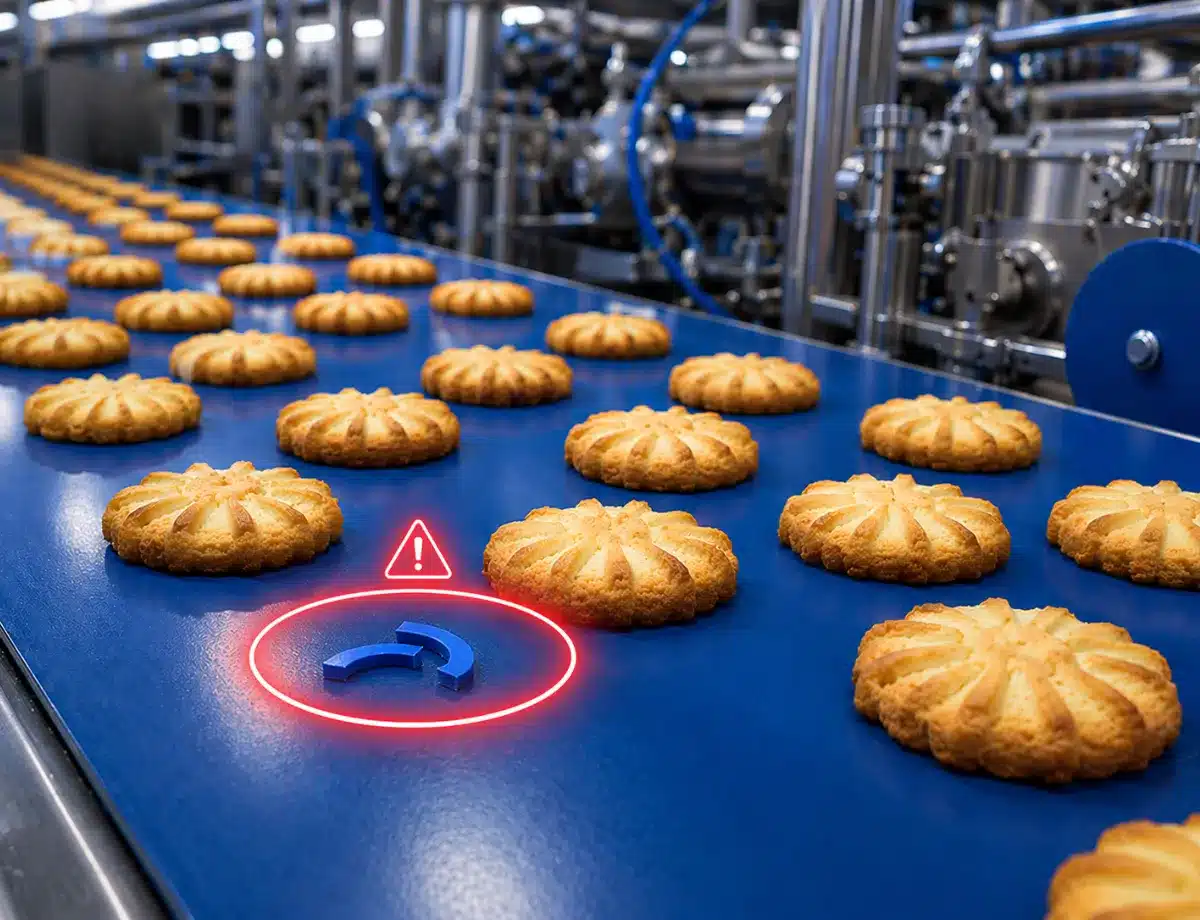
In food processing, contamination by foreign bodies is an ever-present concern. When discussing quality controls, attention often focuses on metal fragments, but there is another risk that deserves even greater attention: contamination by plastic particles.
Components of mixing machines, packaging systems, belts, guides, tools, cable ties, and accessories can wear out or break accidentally, generating fragments that end up in the production line. The critical point is that standard plastics, in their natural state, are difficult to detect with conventional metal detectors. Plastic can be a concrete source of contamination, and visual inspection alone is often insufficient.
Where the Risk Really Originates
The risk does not depend solely on the presence of plastic in the line. It depends on the combination of three factors:
- wear or accidental breakage of the component
- difficulty in detecting the fragment
- impact of the contaminant on the product, safety, and reputation
This means the problem must be addressed upstream, during component design and material selection.
Why Visual Inspection Alone Is Not Sufficient
Many companies still rely on visual inspection to intercept plastic fragments. However, when the piece is small, transparent, or chromatically similar to the finished product, the margin of error increases significantly.
For this reason, detectable materials represent an interesting technical solution: they make it possible to transform a polymeric component into an element potentially detectable by in-line control systems, reducing the probability that contamination goes unnoticed.
The Role of Detectable Compounds
The LATI MDT compounds were developed precisely to meet this need. The brochure explains that these are homogeneous materials, ready to be processed, available on various polymeric matrices, from standard resins to high-performance polymers. The level of detectability is integrated into the formulation logic and is indicated in the product name.
This makes it possible to work not only on safety, but also on production continuity. A detectable component can in fact contribute to making the control plan more robust, without forcing the company to sacrifice the typical performance of engineering thermoplastics.
Which Components Should Be Reconsidered First
In a food processing line, the first candidates for an upgrade to detectable materials are often:
- conveyor components
- buckets and transport systems
- cable ties and fastening elements
- tools and line accessories
- parts subject to impact, friction, or frequent washing
- housings and supports in proximity to the product
In short, this covers a wide range of applications: bucket conveyors, conveyor belts, cable ties, accessories, tools and housings, structural components, and even thin films and tubes.
True Prevention: Material + Design + Testing
Detectable material should not be considered a shortcut. Effective prevention arises from the integration of:
- selection of the correct resin
- component design
- resistance to wear and detergents
- consistency with the detection system
- testing under real operating conditions
This is also an important point from a communication perspective: the message should not be “the material eliminates all risk,” but “the material helps make control more effective and the system safer.”
Conclusion
In food processing, reducing the risk of plastic contamination means thinking more strategically about material selection. Detectable compounds do not replace a good quality plan, but they can significantly strengthen it, especially at points in the line where wear, breakage, and hygiene criticalities are most likely.
Do you want to identify the most critical components in your line and understand which can be redesigned with detectable materials? The LATI team can support you in the technical evaluation.
 Accessibility Statement