

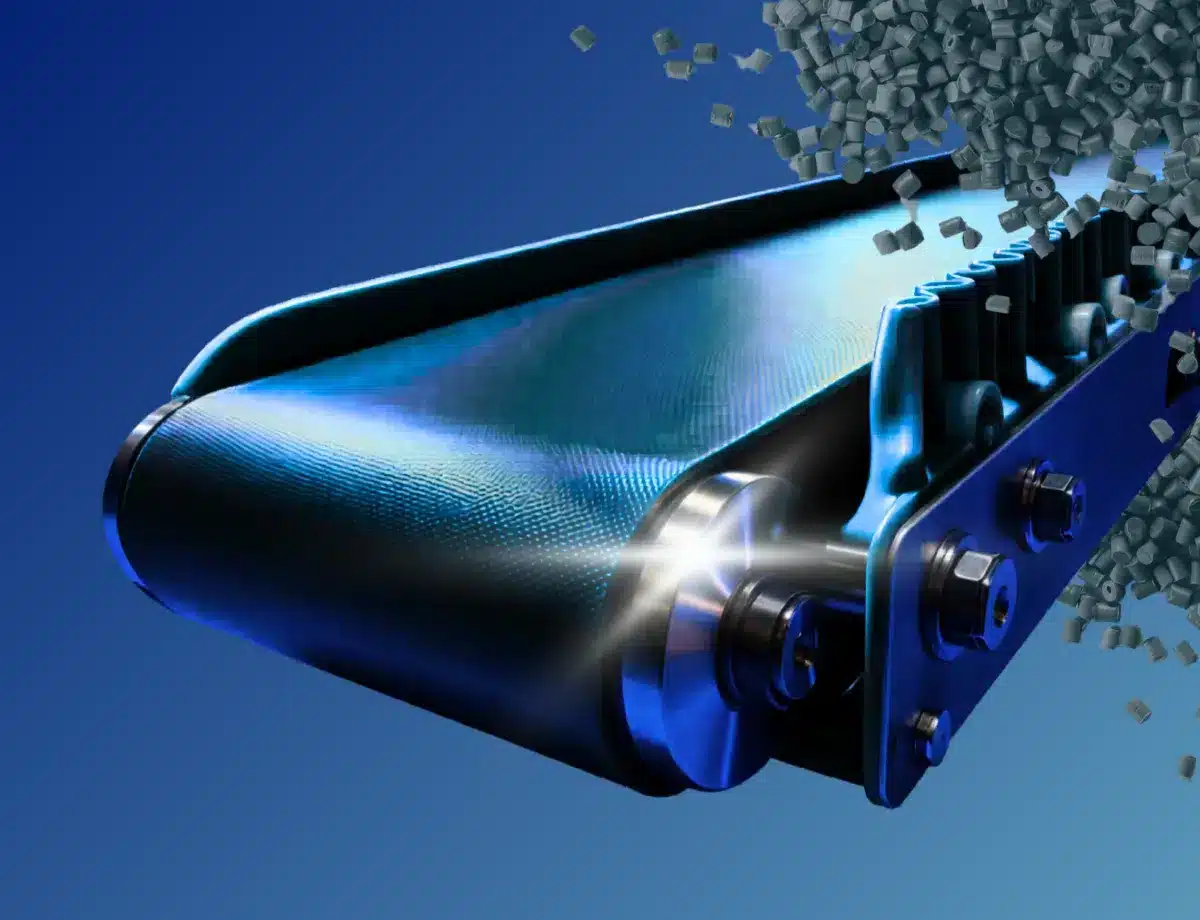
In food processing, the conveyor system is not simply a transport element. It is a critical part of the line, subjected to continuous loads, frequent wash cycles, chemical agents, temperature variations and repeated mechanical stress. In this context, choosing the correct material for belts, modules, guides and accessory components means working on two levels simultaneously: process performance and contamination risk reduction.
The problem is well known: many plastic components used in food handling lines can wear, chip or break accidentally. When this happens, the fragments generated are not always detectable by traditional control systems, especially if they are standard plastics. This is precisely why LATI has developed the MDT range, designed to make plastic elements detectable by metal detectors and, for some grades, also by X-ray systems.
Why Conveyor Belts Are a Critical Point
Modular belts, continuous spirals, soft belts, bucket elevators and transport systems in food areas work under very critical conditions. They must maintain dimensional stability, wear resistance, good sliding properties and compatibility with the detergents used in cleaning and disinfection cycles. At the same time, they must contribute to the safety of the finished product.
It is therefore not surprising that companies such as GANAL and Forbo have chosen LATI solutions for conveyor applications in the food sector, leveraging precisely the combination of detectability, resistance and operational reliability.
Soft Belt or Modular Belt: The Material Changes
There is no single “detectable material for conveyors.” The choice depends on the type of component and the production process.
For soft belts, tubes and extruded or calendered sheets, polyurethane-based grades are recommended, suitable for manufacturing soft conveyor belts and detectable tubes. For rigid elements of modular belts, POM grades are recommended, developed to offer rigidity, impact resistance, chemical inertness and low coefficient of friction, all fundamental properties in food handling systems.
The Properties That Really Matter
When selecting a detectable compound for food conveyor belts, there are at least six criteria to analyze:
Detectability
The material must be consistent with the inspection system present on the line. In many applications where magnetic detectors are used, the MDT05 level represents a balanced baseline; when the required control level increases, or when working with X-ray systems, it may be necessary to move to higher grades, for example from MDT07 upwards.
Friction and Wear
On modules, guides and moving components, the material must limit consumption and noise, maintaining good sliding properties over time.
Chemical resistance
Detergents, sanitizers, oils and process residues require good chemical inertness to avoid premature degradation.
Thermal stability
Cold rooms, hot environments, washing and thermal shocks can compromise part stability and service life if the base polymer is not adequate.
Food Contact
Compliance of the base resin and additives used with current regulations is a prerequisite, not a plus.
Antistatic Properties
In some transport applications, especially with dry or light products, the accumulation of electrostatic charge can promote product adhesion to the surface. For this reason, LATI has also developed antistatic MDT grades intended for conveyor systems.
The Most Common Mistake: Choosing the Material Based on Detectability Alone
Detectability is fundamental, but alone it is not enough. A material that is easily detectable but has poor wear resistance or is unstable after washing can itself become a critical issue. The point is not only to “make the fragment visible to the detector,” but to reduce the probability that the fragment is generated.
The compound must be selected for the actual application, considering geometry, process, environment and detection system. We at LATI expressly recommend testing materials under real operating conditions.
Conclusion
For food conveyor belts, the ideal material is not the one with the highest detectability alone, but the one that finds the right balance between safety, durability, processability and line compatibility. This is where a properly designed detectable compound makes the difference: not as a simple substitute for standard plastic, but as a concrete lever to improve reliability and quality control. Do you want to evaluate the most suitable material for modules, soft belts or conveyor components for your line? Contact LATI for a technical discussion on the application
 Accessibility Statement