

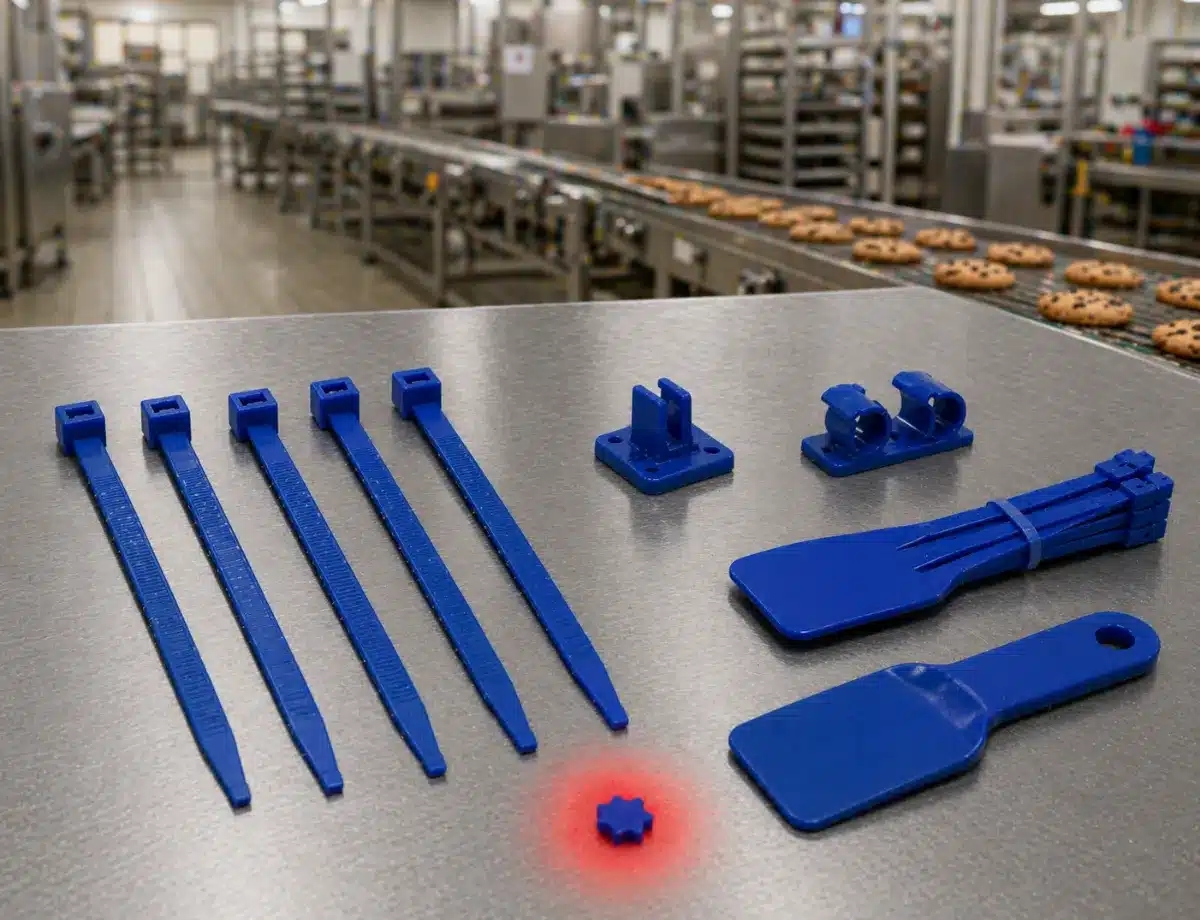
When discussing plastic contamination in food production lines, attention is almost always focused on belts, modules, and machine parts. This is correct, but it is not enough. In many production lines, the smallest components are also the easiest to overlook: cable ties, tools, pens, paddles, dispensers, small supports, and operational accessories.
The problem is simple: these objects are present every day in the production area, often in close contact with machines, operators, and products. If they break, chip, or lose a part, the risk is not theoretical. This is precisely where an interesting opportunity lies: detectable materials are not only for large mechanical components but also for all those details that can turn into an invisible source of contamination.
Why start with minor components
Secondary components typically present three critical issues:
- they are numerous
- they are replaced frequently
- they are easy to break or lose
Furthermore, they are rarely at the center of material improvement projects. Yet, it is precisely here that rapid results in terms of operational safety can be achieved.
The case of cable ties
In the case of cable ties, the material must ensure both flexibility and tear resistance, as well as good processability. Detectability must not compromise the primary function of the part. A detectable cable tie that breaks too easily is not a solution: it is a new problem.
Not just cable ties: tools and accessories as well
Other application cases include pens, paddles, cutters, dispensers, and other line accessories—objects that can be redesigned with MDT materials to improve traceability in the event of accidental breakage.
Which properties really matter
For small components and accessories, the most important selection criteria are:
Mechanical resistance
The part must withstand impacts, bending, tightening, and repeated use.
Detectability consistent with the line
The choice of MDT level must be linked to the inspection systems actually in place.
Color visibility
Blue remains a highly valued standard in the food industry because it also facilitates visual inspection.
Chemical and wash resistance
For components used in environments subject to frequent sanitization, compatibility with detergents and cleaning cycles is essential.
A pragmatic approach for technical offices
If the goal is to reduce risk quickly, it makes sense to start with a very simple audit:
- which small components enter the production area?
- which ones are subject to frequent wear or replacement?
- which ones are close to the product?
- which ones, if broken, would be difficult to trace?
Very often, the first effective actions do not require redesigning the entire machine. It is enough to intervene on a series of apparently marginal but operationally highly exposed details.
Conclusion
Cable ties, tools, and accessories are not a secondary detail in contamination control. They are often the most underestimated point. Including them in a more advanced material selection strategy means strengthening the quality system in a concrete way, without waiting for a non-conformity to intervene.
Do you want to map the most critical minor components of your line and understand which ones can be replaced with detectable versions? LATI can support you in selecting the most suitable material.
 Accessibility Statement