

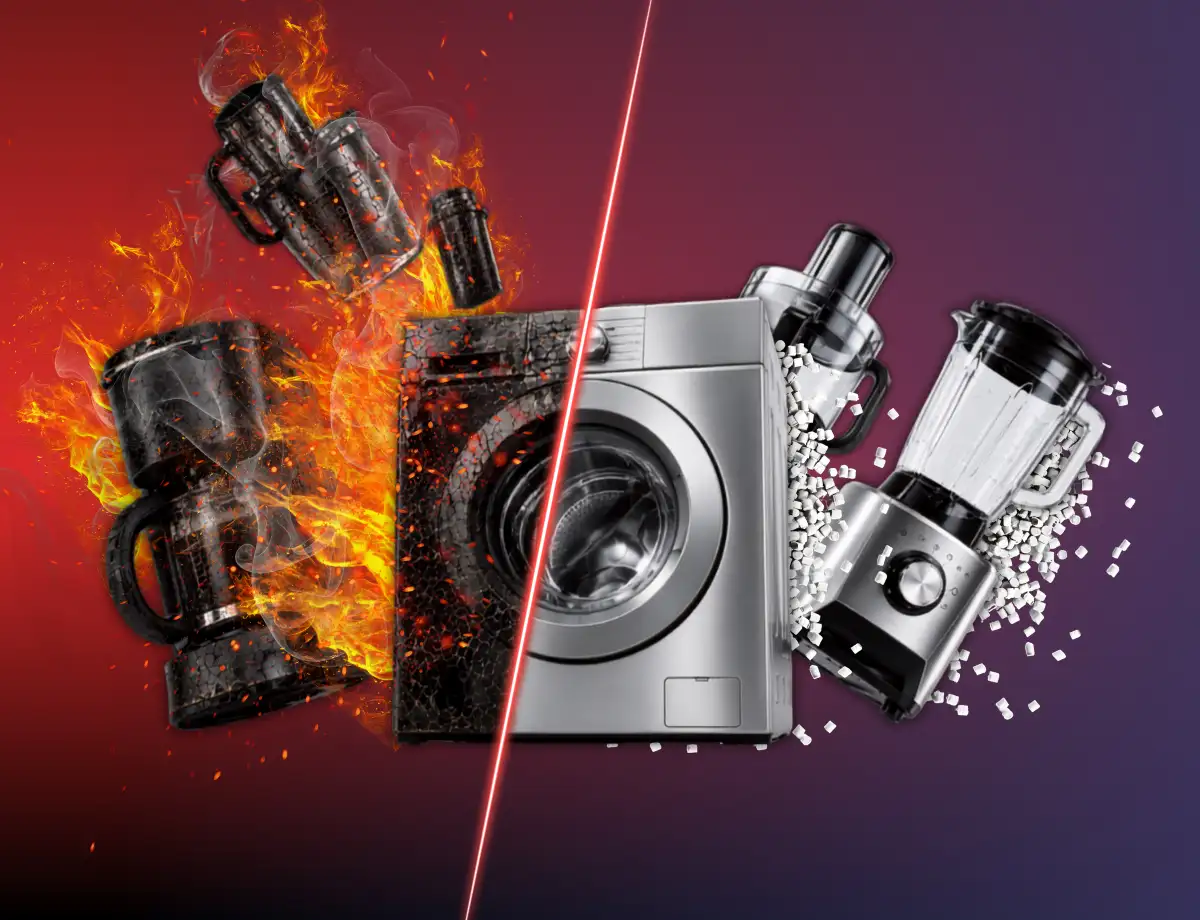
A halogen-free PA66 GF25 compound with VDE-certified GWFI 960°C and GWIT 775°C and UL94 V0 at 0.4 mm for maximum safety appliance applications.
Electrical Safety and Miniaturization: The New Challenges in the Appliance Sector
The evolution of household appliances and electrical devices is imposing increasingly complex challenges on designers. The continuous miniaturization of components, the increase in power density, and the growing integration of electronic functions require plastic materials capable of ensuring high performance even under particularly critical operating conditions.
Connectors, terminal blocks, power distribution systems, batteries, and internal appliance components must now meet increasingly stringent requirements in terms of fire safety and electrical insulation. In this scenario, material selection becomes a determining factor for regulatory compliance and final product reliability.
Why Are GWIT Glow Wire Resistance and UL94 Flame Resistance Fundamental Parameters?
When evaluating plastic materials intended for electrical applications, two of the most important regulatory references are represented by Glow Wire tests and UL94 classification.
The Glow Wire test simulates accidental contact between the plastic material and overheated or incandescent metal components, verifying the material’s ability to resist ignition and not propagate flame.
Specifically:
- GWFI (Glow Wire Flammability Index) measures the material’s ability to self-extinguish after contact with the incandescent wire;
- GWIT (Glow Wire Ignition Temperature) identifies the temperature at which the material tends to ignite.
UL94 V0 classification, on the other hand, certifies the material’s ability to rapidly stop combustion after removal of the flame source.
For many appliance applications compliant with IEC 60335 standard, the simultaneous achievement of high GWFI, GWIT, and UL94 values now represents an essential design requirement.
LATAMID 66 H2 G/25-GWHF1: A New Solution for High-Safety Applications
To meet the needs of electrical component and appliance manufacturers, LATI has developed the new LATAMID 66 H2 G/25-GWHF1, a polyamide 66 reinforced with 25% glass fiber and formulated with a completely halogen-free flame-retardant system.
The material stems from the evolution of the well-established LATAMID V0HF1X platform and offers a particularly balanced combination of fire safety, electrical properties, and processability.
Key technical characteristics include:
- UL94 V0 down to 0.4 mm;
- CTI 600 V;
- HWI PLC0;
- HAI PLC0;
- halogen-free formulation;
- high performance stability across different thicknesses and colors.
These characteristics enable the material to meet the requirements of designers engaged in developing increasingly compact and high-performance components.
[Download the LATAMID 66 H2 G/25-GWHF1 technical data sheet]
Glow Wire Performance at Maximum Levels
One of the most significant aspects of LATAMID 66 H2 G/25-GWHF1 concerns its performance in Glow Wire tests.
The compound achieves:
- GWFI 960°C
- GWIT 775°C
across a wide range of thicknesses, offering a particularly interesting solution for applications subject to IEC 60335 requirements.
Completing the performance profile is a Ball Pressure Test of 230°C, indicating the material’s ability to maintain its integrity even under high thermal stress.
These values position the material among the most advanced solutions available for highly critical electrical components and appliances.
| Typ Type | Glühdrahtentflammbarkeits- zahl (GWFI) Glow-wire flammability index (GWFI) DIN EN IEC 60695-2-12 (VDE 0471-2-12):2022-11; EN IEC 60695-2-12:2021 | Glühdrahtentzündungs- temperatur (GWIT) Glow-wire ignition temperature (GWIT) DIN EN IEC 60695-2-13 (VDE 0471-2-13):2022-11; EN IEC 60695-2-13:2021 | Vergleichszahl der Kriechwegbildung (CTI) Comparative tracking index (CTI) DIN EN IEC 60112 (VDE 0303-11):2026-03; EN IEC 60112:2025 | Temperatur der Kugeldruckprüfung Temperature of the ball pressure test DIN EN 60695-10-2 (VDE 0471-10-2):2016-01; EN IEC 60695-10-2:2014 | Farben Colours |
|---|---|---|---|---|---|
| LATAMID 66 H2 G/25-GWHF1 | 960/0,4 960/0,75 960/1,5 960/3,0 | 775/0,4 775/0,75 775/1,5 775/3,0 | 550 | 230 °C | Alle Farben all colours |
VDE Certification: Added Value for Designers and Manufacturers
In the electrical sector, declaring high performance is not sufficient. It is essential that such performance be validated by internationally recognized independent bodies.
For this reason, VDE (Verband der Elektrotechnik, Elektronik und Informationstechnik) certification represents one of the most valued tools by OEMs, designers, and quality managers.
VDE is one of the leading international bodies for the verification and certification of components, equipment, and materials intended for the electrical and electronic sector. Certification ensures that declared characteristics have been verified according to rigorous procedures recognized by the market.
In the case of plastic materials intended for appliance applications, the presence of VDE-certified Glow Wire values offers numerous advantages:
- greater reliability of technical data;
- simplified component qualification activities;
- reduced validation times;
- easier compliance with industry regulations;
- support for international design activities.
For LATAMID 66 H2 G/25-GWHF1, the GWFI 960°C and GWIT 775°C values are VDE-certified across all thicknesses between 0.4 and 3 mm and across all available technical colors, offering designers an additional element of reliability in material selection.
[Discover LATI VDE-certified materials in the dedicated section]
Ideal Applications for the Appliance and Electrical Sector
Thanks to the combination of high Glow Wire performance, UL94 V0 classification, VDE certification, and excellent electrical properties, LATAMID 66 H2 G/25-GWHF1 finds application in numerous areas.
Key applications include:
- electrical connectors;
- terminal blocks;
- appliance components;
- energy management systems;
- charging devices;
- battery and energy storage components;
- electrical parts subject to IEC 60335 requirements.
The ability to maintain high performance even at low thicknesses makes the material particularly interesting for miniaturization-oriented projects.
A Halogen-Free Approach Without Compromises
Growing attention to safety, sustainability, and regulatory compliance is accelerating the adoption of halogen-free flame-retardant systems.
LATAMID 66 H2 G/25-GWHF1 adopts a completely halogen-free formulation, also free of red phosphorus, enabling the combination of high fire safety performance with greater attention to environmental and safety aspects.
The result is a material designed to meet current and future needs of the electrical sector, offering designers a reliable, certified solution ready for the most demanding applications.
FAQ
What Is the Difference Between GWFI and GWIT?
GWFI measures the material’s ability to self-extinguish after contact with the incandescent wire, while GWIT indicates the temperature at which the material tends to ignite.
Why is VDE certification important?
It ensures that declared performance has been verified by an internationally recognized independent body, increasing the reliability of technical data.
What Does UL94 V0 at 0.4 mm Mean?
It means the material meets UL94 V0 classification even at very thin thicknesses, a particularly important requirement in miniaturized components.
Which Applications Require High GWIT Values?
Primarily household appliances, connectors, power supply systems, batteries, and components subject to IEC 60335 standard requirements.
Does LATAMID 66 H2 G/25-GWHF1 Contain Halogens?
No, the material is completely halogen-free and is formulated without red phosphorus.
 Accessibility Statement