

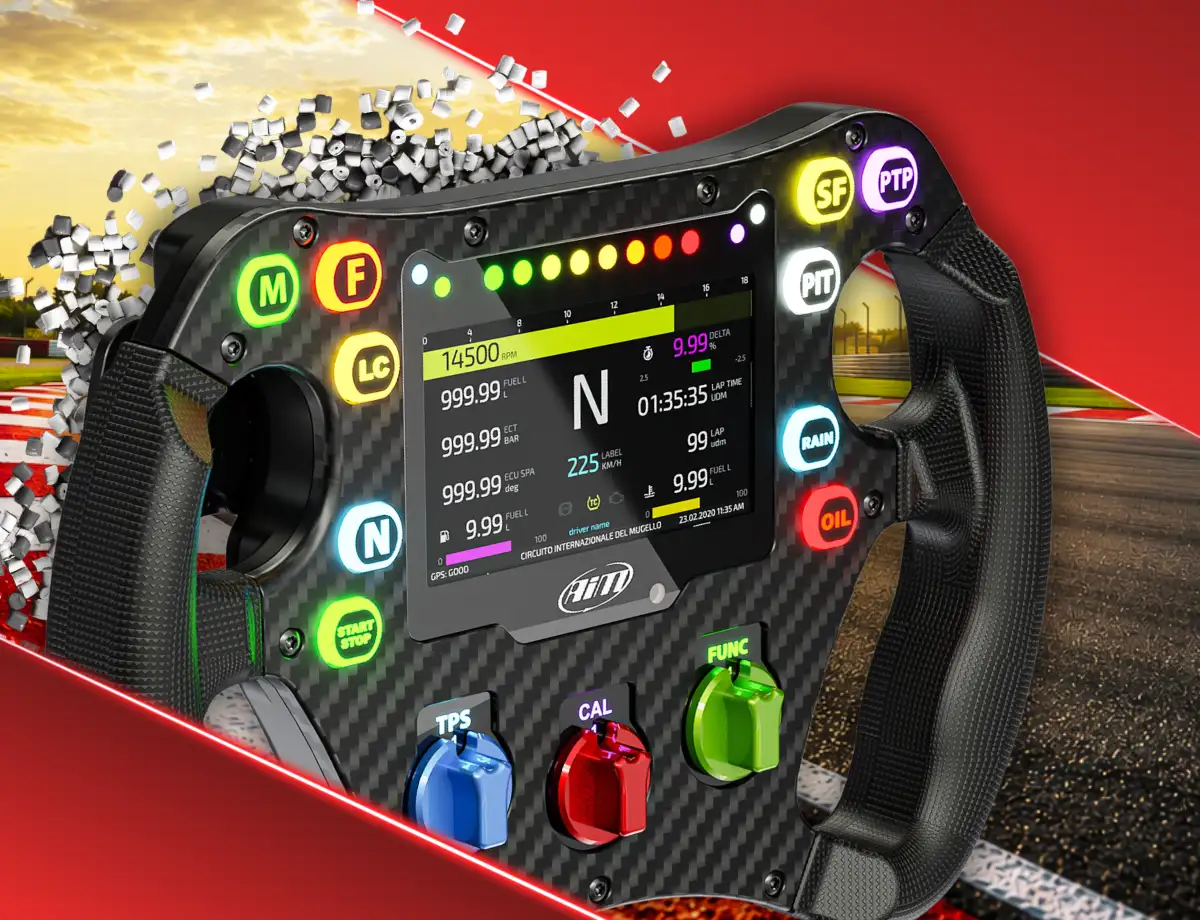
In modern motorsport, data management has become as fundamental an element as the vehicle’s mechanical performance. Real-time information acquisition and processing must ensure absolute precision, reliability, and operational continuity even under the most extreme conditions.
In this scenario, the materials used for structural components also take on a strategic role. Lightness, rigidity, geometric precision, and aesthetic quality become essential requirements for integrating advanced electronics and racing performance.
Data management in motorsport: uncompromising reliability
Proper data collection and management has become an essential necessity in the automotive sector to ensure the correct operation of all types of vehicles, from two-wheelers to heavy transport vehicles.
In the racing field, this need is further amplified: even minimal fluctuations in the quality of data acquisition and processing can compromise the outcome of a competition.
AIM-Sportline: advanced electronics for the racing world
AIM-Sportline is a Milan-based company specializing in the design and construction of electronic devices dedicated to data management for motorsport.
The AIM catalog includes:
- digital displays
- data loggers
- video cameras
- sensors
- power distributors
- advanced electronic control units
Among the various product categories, competition steering wheels stand out—highly technologically integrated systems where electronics, ergonomics, and design converge into a single solution.
Racing steering wheels and advanced electronic integration
The SW4 steering wheel represents one of the most versatile platforms developed by AIM-Sportline.
Compatibility with over 2,000 ECU protocols allows the system to be adapted to numerous racing configurations, while integrated keypads, buttons, and TFT displays allow for continuous interaction with the vehicle.
This sophisticated electronic architecture requires a structure capable of combining:
- mechanical precision
- dimensional stability
- aesthetic quality
- comfort and safety
Carbon-reinforced engineering polymers for motorsport applications
To meet these requirements, AIM-Sportline chose LATI technical compounds, molded by the professionals at G.S.T. Plast in Canonica d’Adda.
The solution adopted is LATAMID 66 H2 K/50, a PA66 polyamide reinforced with 50% high-tenacity carbon fiber.
The material is used for the production of:
- steering wheel front panel
- accessory shift pads
[Discover LATAMID 66 H2 K/50 and download the complete technical data sheet here]
PA66 with carbon fiber: lightness and structural precision
The high carbon fiber content ensures properties particularly suitable for motorsport:
- high rigidity
- structural lightness
- dimensional stability
- dimensional stability
- chemical resistance to oils and greases
These characteristics are fundamental in components that must maintain extremely precise dimensional tolerances even in the presence of vibrations, loads, and thermal variations.
Molding precision and electronics integration
One of the most critical aspects of the project concerns the absolute precision of the numerous:
- holes
- passages
- fixing points
present on the steering wheel front panel.
The component acts as the main load-bearing structure for the entire onboard electronics, requiring levels of precision obtainable only through the combination of:
- high-performance material
- accurate design
- high-quality molding
Aesthetic finish and water transfer printing
The material also successfully passed the subsequent water transfer printing treatment, a decorative process involving the application of a printed film in an aqueous solution.
The final result perfectly reproduces the typical aesthetics of carbon fiber composites, combining:
- aesthetic quality
- surface precision
- mechanical performance
Advanced engineering polymers for the future of racing
The use of carbon-fiber-reinforced engineering polymers demonstrates how high-performance plastic materials can support extremely advanced motorsport applications.
The possibility of integrating:
- lightness
- geometric precision
- structural stability
- advanced electronics
makes these compounds a strategic solution for next-generation racing platforms.
FAQ – Engineering polymers for motorsport and racing steering wheels
Why use carbon fiber in engineering polymers?
Carbon fiber increases the rigidity, lightness, and dimensional stability of the component.
What advantages does carbon-reinforced PA66 offer?
High mechanical strength, reduced deformation, and excellent chemical resistance.
Are engineering polymers suitable for racing components?
Yes, especially in applications where weight, precision, and electronic integration are fundamental.
What is water transfer printing in plastic components?
It is a decorative process that allows for the application of surface films to achieve advanced aesthetic finishes.
Which motorsport components use advanced engineering polymers?
Racing steering wheels, electronic supports, structural components, and data management systems.
 Accessibility Statement