

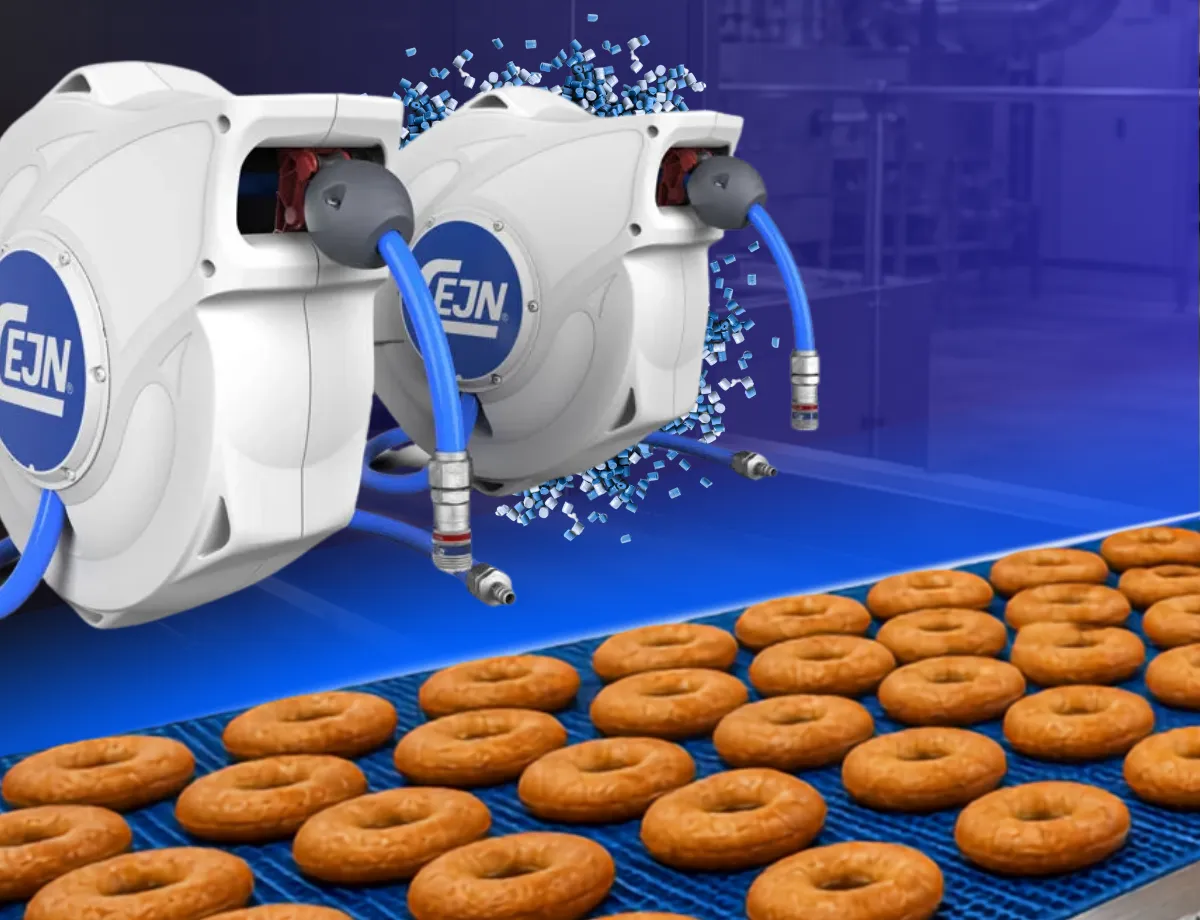
In the food industry, even a small plastic component can play an important role in supporting safer processes by preventing contamination. At the same time, materials must combine functional performance with detectability.
This case study describes how CEJN, a Swedish company which already collaborated with LATI, developed a detectable stop ball for hose reels intended for food industry applications. The project required more than a standard material choice as the component needed to combine compliance with food industry requirements, magnetic and X-ray detectability, and the performance expected from a technical part.
The challenge: combining detectability and performance in a reliable component
The application at the center of this project is a stop ball for hose reels used in food industry environments. For CEJN, the challenge was to identify a material suitable for a new molded component designed to meet challenging requirements. Actually, the material had to be suitable for food industry environments, detectable through magnetic and X-ray systems, and capable of delivering the right balance of softness, toughness and functional reliability.
This made the project more complex than a conventional replacement of one plastic with another. The target required the formulation of a brand-new material developed around the real needs of the component and its production process.
A development approach built around the application
As part of CEJN’s ongoing development of MDT solutions for food industry applications, this project required a close collaboration between material and product development teams.
The introduction of a new component geometry and dedicated molds meant that material performance, processing behavior, and end-use requirements had to be considered simultaneously from the earliest stages of development.
LATI’s contribution: a new soft detectable compound
LATI supported the project through development of a new flexible compound, working on a new soft detectable polymeric matrix specifically formulated for the stop ball application.
Detectability was essential, but so was the behavior of the component in its actual working conditions, including impact, temperature and chemical exposure, as well as during molding.
By developing a dedicated compound for the application, LATI helped transform a technical need into a real molded solution. The selected material is an elastomer based highly detectable grade, LASTIFLEX MDT09-01.
Conclusion
This project highlights the importance of close collaboration between material engineering and product development when designing components for demanding food industry environments.
By combining application expertise with custom material development, CEJN and LATI created a detectable stop ball solution that meets both safety expectations and functional performance requirements.
The result is a purpose-designed component supported by a dedicated detectable elastomer compound developed specifically for the application.
 Accessibility Statement