

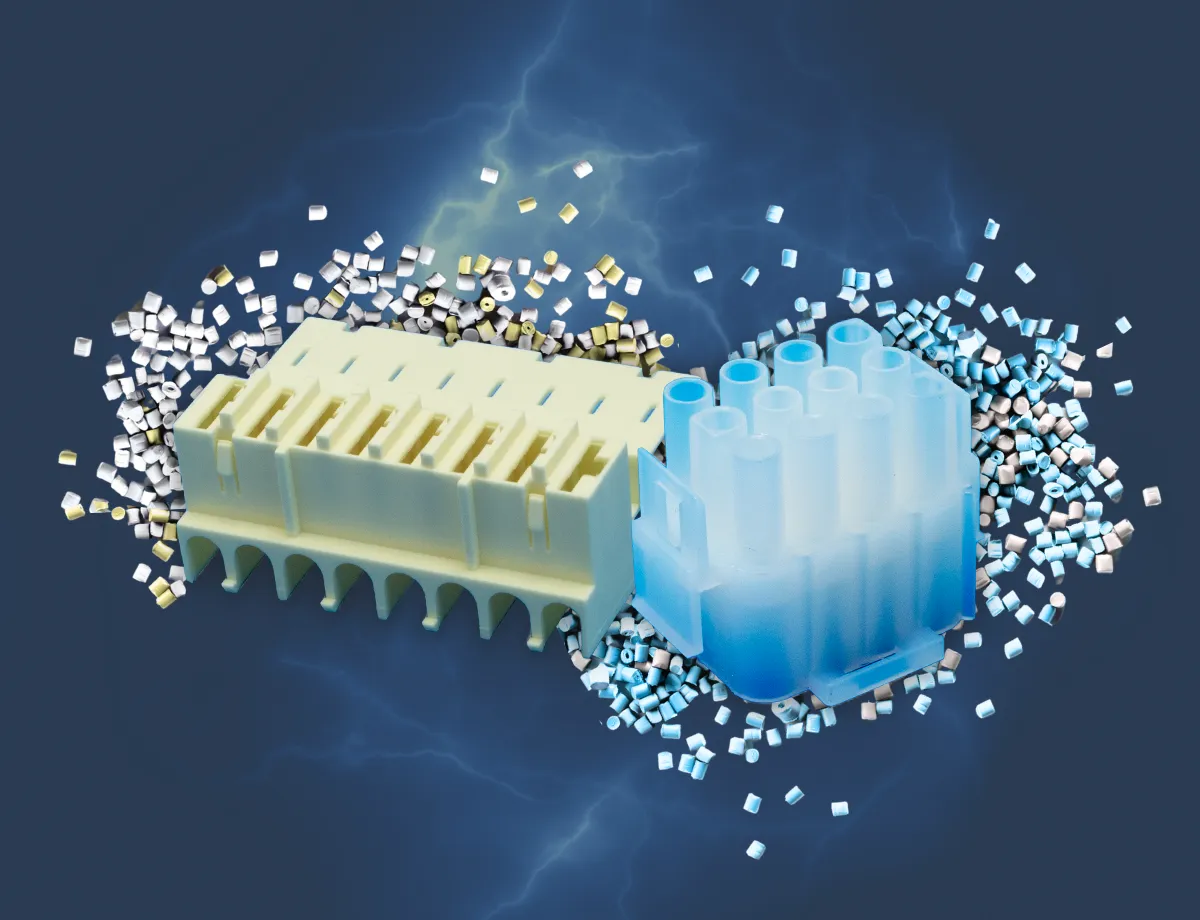
Materials for electrical connectors: PA6, PA9T, and flame-retardant compounds for high temperatures, high GWIT, and automotive and appliance applications.
The evolution of electrical and electronic systems in the automotive, appliance, and power management sectors is imposing increasingly stringent requirements on electrical connectors. High operating temperatures, increased transferred currents, and progressive miniaturization require materials capable of ensuring safety, reliability, and long-term stability.
In this context, the choice of engineering polymer becomes a key element of the design, on par with component geometry.
Electrical Connectors: Technological Challenges
In both automotive and appliance sectors, connectors must operate under increasingly critical conditions.
The main challenges include:
- operating temperatures above 150°C
- high electrical currents
- reduced spaces and miniaturized geometries
These factors must be managed while simultaneously ensuring electrical safety, thermal resistance, and regulatory compliance.
Design and Materials: Safety and Versatility
Safety and versatility represent central elements in the development of electrical connectors.
Component performance depends on:
- geometric design
- material behavior
- dimensional stability
- heat and flame resistance
Material selection must therefore simultaneously meet mechanical, thermal, and electrical requirements.
The Role of CS Connectors in the Electrical Interconnection Sector
CS Connectors of Cernusco sul Naviglio has been operating for over fifty years in the precision electrical interconnection sector.
The experience gained enables the company to meet the needs of various application areas:
- automotive
- appliance
- industrial power management
- data centers
The connectors developed are designed to ensure:
- maximum safety
- long-term reliability
- ease of use
- high performance
LATAMID 6 H2 PX-V2 EK1: Miniaturization and Glow Wire Resistance
For appliance sector applications, CS uses LATAMID 6 H2 PX-V2 EK1, a toughened flame-retardant polyamide 6.
Key features include:
- UL94 V2 classification from 0.4 to 3 mm
- high glow wire resistance (GWIT 825°C at 0.4 mm)
- excellent flowability for molding complex geometries
- elongation at break exceeding 20%
These properties make the material particularly suitable for miniaturized connectors with hinge effect, in compliance with IEC 60335 standards.
[Download the technical datasheet for LATAMID 6 H2 PX-V2 EK1 here]
LARAMID T G/30-V0HF1: High-Temperature Performance
For more severe applications, with temperatures above 150°C and currents exceeding 200 mA, CS has successfully tested the male and female connectors CS-LK12M and CS-LK12F made from LARAMID T G/30-V0HF1.
This material is characterized by:
- semi-aromatic polyamide PA9T
- 30% glass fiber reinforcement
- halogen-free V0 flame retardancy
The combination of these properties ensures thermal stability and resistance under critical operating conditions.
[Download the technical datasheet for LARAMID T G/30-V0HF1 here]
Alternatives in Reinforced and Unreinforced PA6
Other LATI materials have also been tested on the same geometries:
- LATAMID 6 H2 G/30-V0HF1, PA6 reinforced with 30% glass fiber, halogen-free
- LATAMID 6 H-V0, unreinforced flame-retardant PA6
These solutions offer a balance between performance, processability, and application requirements.
Materials for E-Mobility: Resistance and Long-Term Stability
All the materials mentioned have also been molded in RAL2003 orange, the standard color for e-mobility applications.
It is important to note that:
- they have passed automotive aging tests
- 1,000 hours at 90°C without significant degradation
This confirms the suitability of the materials for high-reliability electrical applications in the electric mobility sector.
Materials for Connectors: Integration of Performance and Standards
Material selection for electrical connectors must simultaneously consider:
- fire behavior (UL94, GWIT)
- thermal resistance
- mechanical properties
- dimensional stability
- regulatory compliance
The use of advanced engineering polymers enables these requirements to be met while maintaining high safety and reliability standards.
FAQ – Materials for Electrical Connectors
What materials are used in electrical connectors?
Polyamides (PA6, PA66, PA9T) and flame-retardant engineering polymers, often reinforced with glass fiber.
What does GWIT mean in plastic materials?
GWIT (Glow Wire Ignition Temperature) indicates the temperature at which the material resists ignition from a glow wire.
Why must connectors resist high temperatures?
To ensure safety and reliability in the presence of high currents and thermally critical environments.
What advantages do halogen-free materials offer?
Greater safety in case of fire and compliance with environmental and safety regulations.
Can engineering polymers replace traditional materials?
Yes, they offer lightness, ease of molding, and functional integration while maintaining high performance.
 Accessibility Statement