

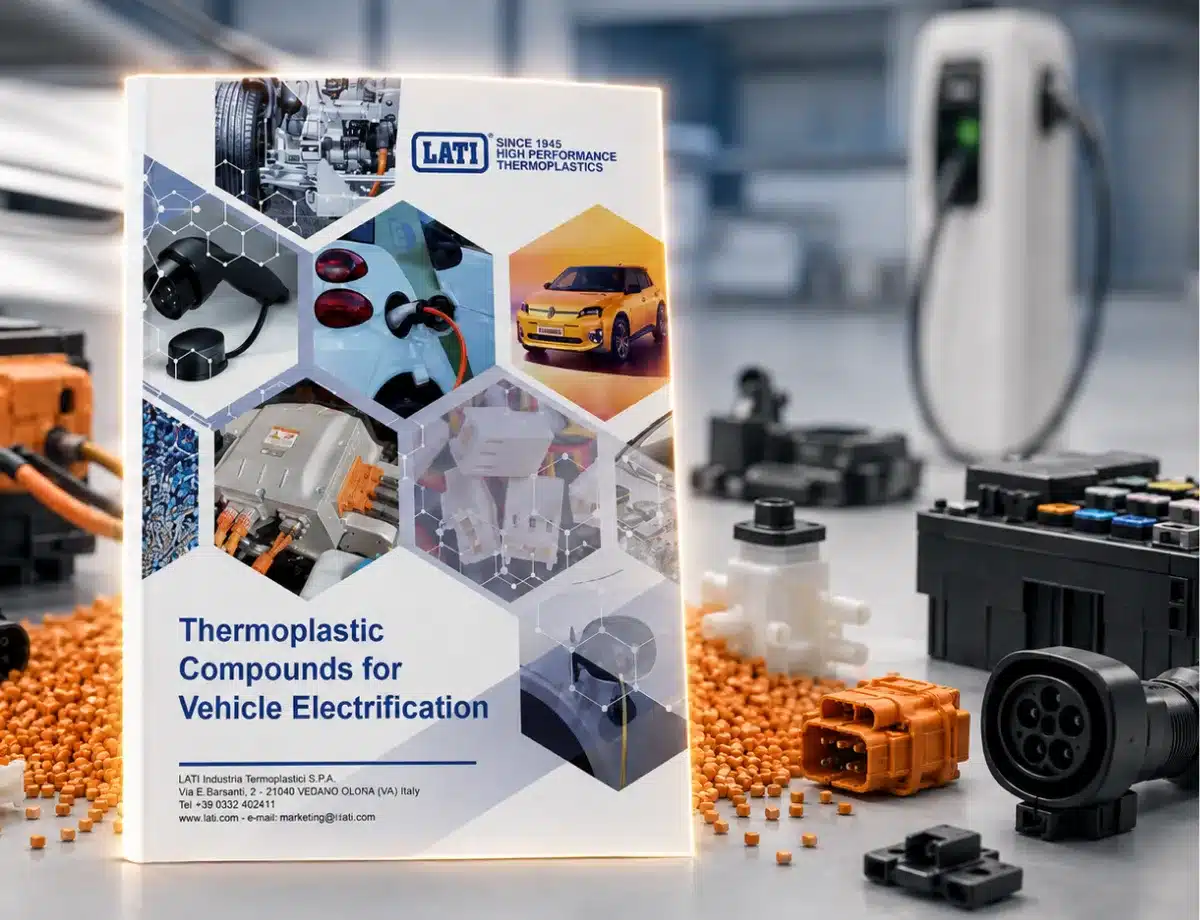
Electrical safety, thermal management, high temperatures, EMI shielding, and sustainability: the new LATI brochure explores the role of engineering polymers in the design of electrified vehicles.
Electrification Changes Automotive Material Requirements
Vehicle electrification is profoundly changing the architecture of automotive systems and, with it, the requirements for materials.
Batteries, charging systems, inverters, connectors, sensors, electronic units, and thermal management components introduce operating conditions in which electrical insulation, flame behavior, high-temperature resistance, heat dissipation, and long-term stability become fundamental parameters from the earliest design stages.
At the same time, the need to reduce weight, simplify components, and minimize environmental impact is increasing interest in thermoplastic compounds capable of replacing metallic materials and traditional solutions where technically feasible.
The new brochure “Thermoplastic Compounds for Vehicle Electrification” brings together LATI’s experience in developing materials for electrified mobility, offering designers, R&D managers, OEMs, and Tier Suppliers an overview of the main available technologies.
Electrical Safety and Flame Behavior
One of the central issues in the design of electrified vehicles concerns the safe management of high voltages and currents.
Structural components, batteries, charging systems, and devices for energy control and transmission must maintain reliable performance during normal operation, charging, and under the most severe operating conditions.
Material selection therefore requires a combined evaluation of properties such as:
- self-extinguishing behavior;
- tracking resistance;
- dielectric strength;
- thermal resistance;
- physical and thermal aging;
- mechanical strength;
- stability under environmental conditions.
LATI has been developing flame retardant and halogen-free HFFR compounds for decades, available on various polymer matrices and formulated to meet the requirements of electrical and electronic applications.
A further aspect concerns the identification of high-voltage circuits. The orange color adopted for these applications must remain recognizable over time even after prolonged thermal exposure. For this reason, LATI has developed formulations with specific color stabilization for HV applications, with solutions also designed for environments characterized by high temperatures and humidity.
High Temperatures and Thermal Management: Two Increasingly Central Challenges
Power electronics, motors, energy conversion systems, and charging devices generate heat that must be managed effectively.
For applications subjected to particularly severe temperatures, the LATI portfolio includes compounds based on PPA, PPS, PSU, PESU, PPSU, and PEEK, with materials designed to operate beyond the traditional limits of technical polyamides.
But resisting heat is not enough: in many systems it is also necessary to transfer it.
The LATICONTHER range uses graphite and special ceramics dispersed in the polymer matrix to obtain thermally conductive compounds, with values that can reach and exceed 28 W/mK.
These formulations make it possible to combine thermal conductivity with the typical advantages of thermoplastic materials, such as:
- weight reduction;
- design freedom;
- chemical and environmental resistance;
- processability by molding;
- functional integration capability.
The range also includes electrically insulating, self-extinguishing solutions stabilized for specific environmental conditions.
Protecting Electronics from Electromagnetic Interference
The increasing number of electronic systems, sensors, and connected devices makes electromagnetic compatibility another increasingly important element in automotive design.
LATISHIELD compounds are developed to protect electronic systems from interference generated by external electric and electromagnetic fields.
Through the use and combination of specific fillers, including stainless steel fibers, carbon fibers, and nanotubes, it is possible to create an electrically conductive structure within the polymer matrix.
Depending on the formulation, the brochure presents solutions with shielding efficiency ranging from 30 to 90 dB, showing how engineering polymers can also contribute to the design of components for electronics protection.
Can Electrification and Sustainability Proceed Together?
The transition to electric mobility is not only about propulsion technology.
Reducing the environmental footprint of the vehicle also requires attention to the materials used in individual components.
With the LATIECO range, LATI develops high-performance compounds from recycled raw materials through mechanical or chemical recycling processes, with reinforced, self-extinguishing formulations also intended for complex technical applications.
The portfolio includes solutions with different percentages of recycled content and formulations designed to reduce the carbon footprint while maintaining as much as possible the characteristics required of equivalent conventional solutions.
The brochure also shows how different technologies can converge in the same material: a compound can, for example, combine recycled raw material and thermal conductivity, transforming sustainability from a separate requirement into a true design parameter.
Not Just Materials: Technical Support from Design to Industrialization
The growing complexity of electrified systems makes compound selection only part of the process.
LATI supports customers from the earliest design stages through co-design, FEM simulation, development of dedicated formulations, molding support, and assistance in certification and compliance processes.
The entire LATI industrial system is also certified IATF 16949:2016, the reference standard for quality management systems in the automotive supply chain.
The objective is to evaluate the material not as an isolated element, but within the actual operating conditions of the component: geometry, process, mechanical stresses, temperature, operating environment, and regulatory requirements.
A New Brochure for Designing Electrified Mobility
Which material to choose for a component near a heat source? How to combine electrical insulation and self-extinguishing behavior? When is it necessary to use a thermally conductive compound? And which solutions can contribute to EMI shielding or carbon footprint reduction?
The new brochure “Thermoplastic Compounds for Vehicle Electrification” explores these topics through material families, technical data, compound examples, and possible applications for the new mobility.
A tool designed for designers, material specialists, R&D managers, OEMs, Tier 1 and Tier 2 suppliers engaged in the development of components for electric vehicles, hybrids, and advanced mobility systems.
Download the brochure “Thermoplastic Compounds for Vehicle Electrification” and discover LATI solutions for electrical safety, thermal management, EMI shielding, high temperatures, and sustainability.
FAQ
What plastic materials are used in electric vehicles?
In electrified vehicles, engineering polymers and special compounds are used based on, among others, PA, PPA, PBT, PPS, polysulfones, and PEEK. The matrix and formulation are selected according to temperature, electrical requirements, flame behavior, and environmental conditions.
What characteristics must a compound have for high-voltage automotive components?
In addition to mechanical properties, electrical insulation, dielectric strength, CTI, flame behavior, thermal and environmental stability must be evaluated. For HV components, it is also important to maintain correct color identification over time.
What are thermally conductive compounds used for in electric vehicles?
Thermally conductive compounds can contribute to the dissipation of heat generated by electronics, LEDs, power devices, and other systems, while offering weight reduction and functional integration possibilities compared to certain metallic solutions.
What are EMI shielding compounds?
They are thermoplastic materials formulated with electrically conductive fillers capable of attenuating electromagnetic interference and contributing to the protection of sensors, electronics, and control systems.
Is it possible to use recycled plastics in electric vehicle applications?
Yes, provided the formulation is designed and validated according to the application. The LATIECO range includes compounds from mechanical and chemical recycling developed to combine reduced environmental impact and technical performance.
 Accessibility Statement